
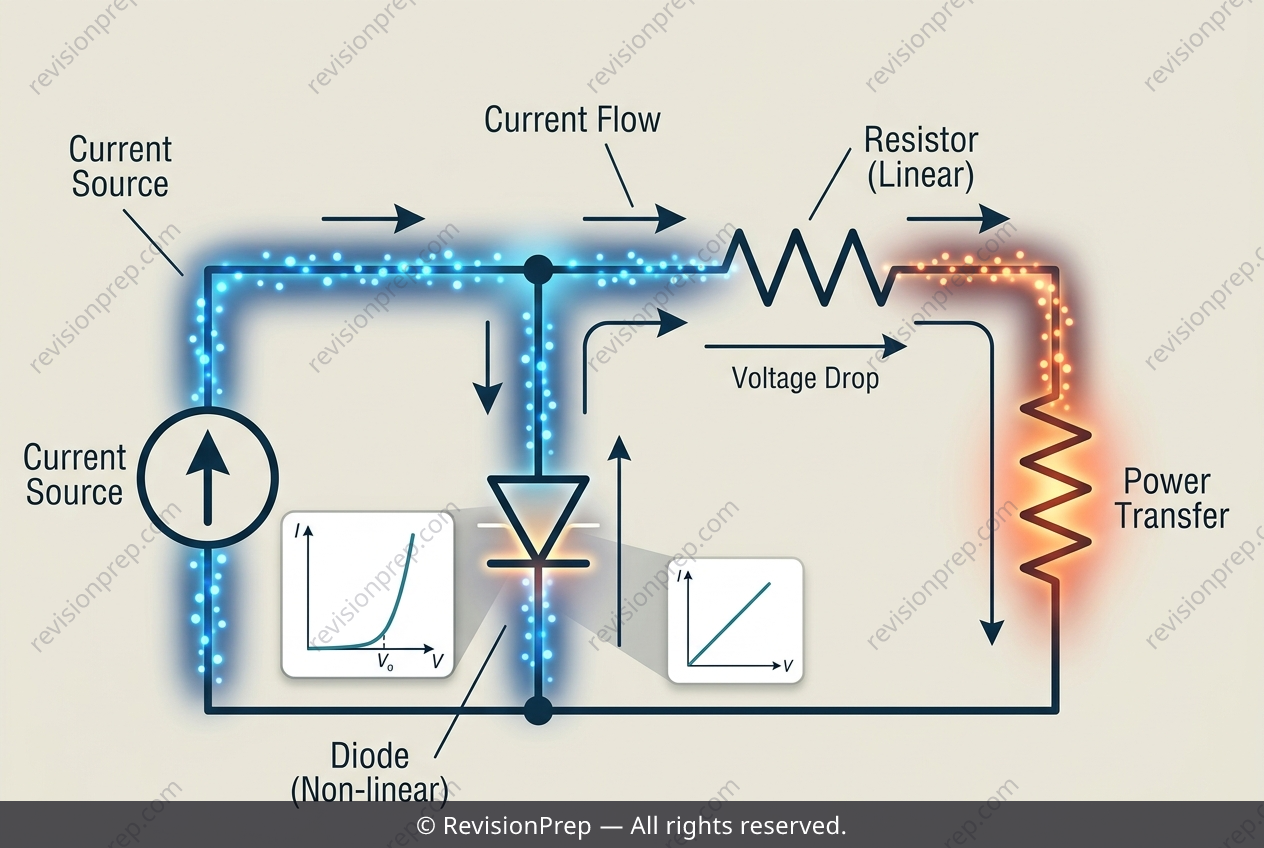
Physics: How a Diode Clamps a Solar Cell’s Voltage
When a photovoltaic cell drives a load, it rarely behaves like a simple battery. Instead, it is best modelled as a constant current source in parallel with a diode and the load resistor. The key to understanding this circuit lies in the diode’s clamping action: once conducting, it holds the voltage across its terminals—and therefore across any parallel component—at a fixed forward drop, here 0.70 V. This single constraint dictates the entire circuit’s behaviour, making the analysis elegant and predictable. This topic matters because real-world power sources, from solar panels to sensors, contain non-linear elements that cannot be described by Ohm’s law alone. The diode’s fixed voltage drop decouples the load voltage from the source current, meaning the load current is simply Vdiode / Rload. Kirchhoff’s current law then forces the remaining source current to flow through the diode. Adding a series resistance Rs does not disturb this voltage clamp—it only consumes power as I²Rs, reducing overall efficiency while leaving the load power untouched. Understanding this interplay between clamping, current division, and series losses is essential for analysing any practical DC power system.
Start practising IB questions today
150,000+ IB-styled questions, criteria-mapped and instantly accessible.