
Physics: How Energy Balances in Simple Harmonic Motion
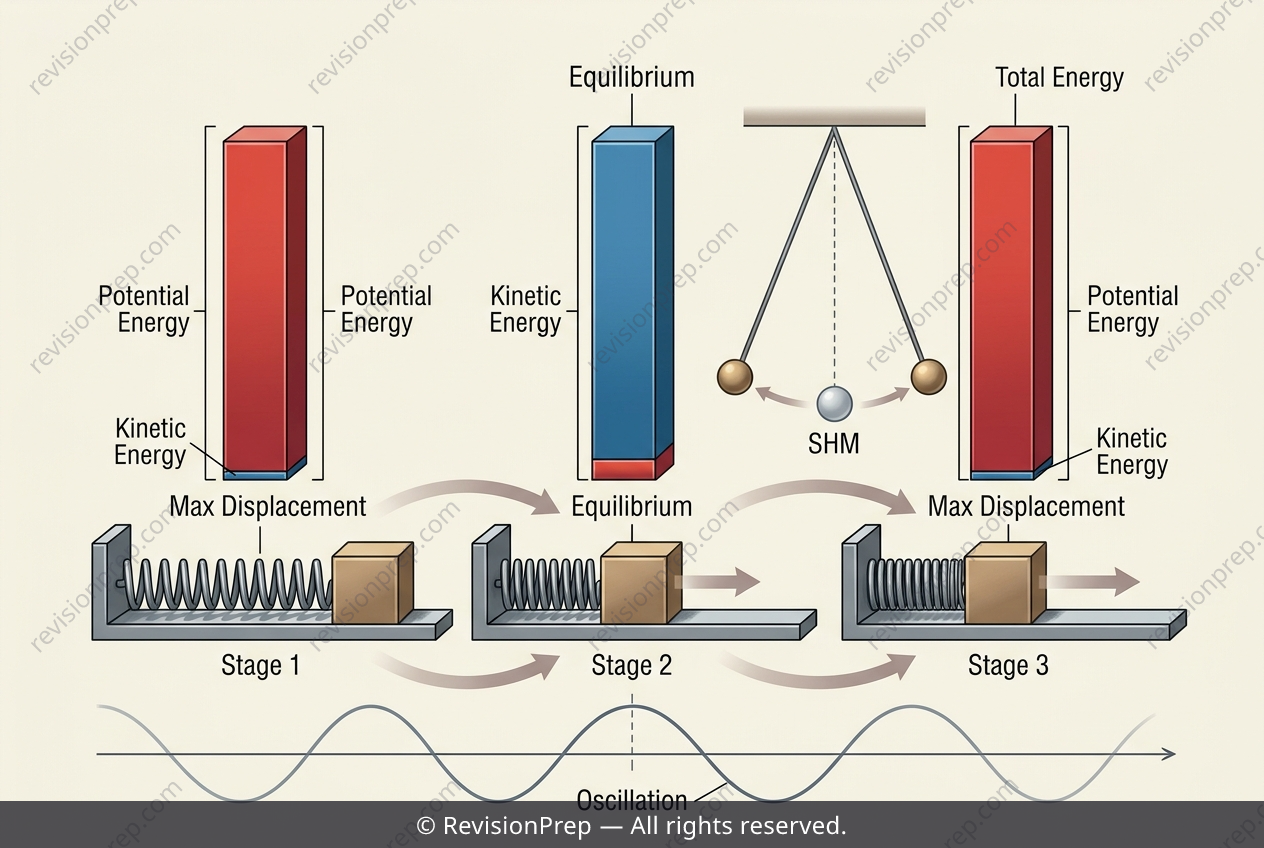
In simple harmonic motion (SHM), a system oscillates because it continuously swaps energy between two forms: kinetic energy, linked to motion, and potential energy, linked to displacement from equilibrium. The core idea is that, in the absence of friction or other dissipative forces, the total mechanical energy of the system remains constant throughout the cycle. This conservation principle is what gives SHM its predictable, repeating nature, from a pendulum’s swing to the vibration of a mass on a spring. The key relationship emerges at the extremes of motion. At maximum displacement—the amplitude—the particle momentarily stops, so its kinetic energy drops to zero. At that instant, all the mechanical energy is stored as potential energy. Because the potential energy curve for SHM is parabolic (E_p ∝ x²), it reaches its peak value exactly at the amplitude. Meanwhile, as the particle passes through equilibrium (x = 0), potential energy falls to zero, and all energy becomes kinetic. Since total energy is conserved, the maximum potential energy at the amplitude must equal the total mechanical energy of the system—and also equal the maximum kinetic energy at equilibrium. This balance between the two energy forms, tied by the constant total, is the heart of understanding energy in SHM.
Start practising IB questions today
150,000+ IB-styled questions, criteria-mapped and instantly accessible.