
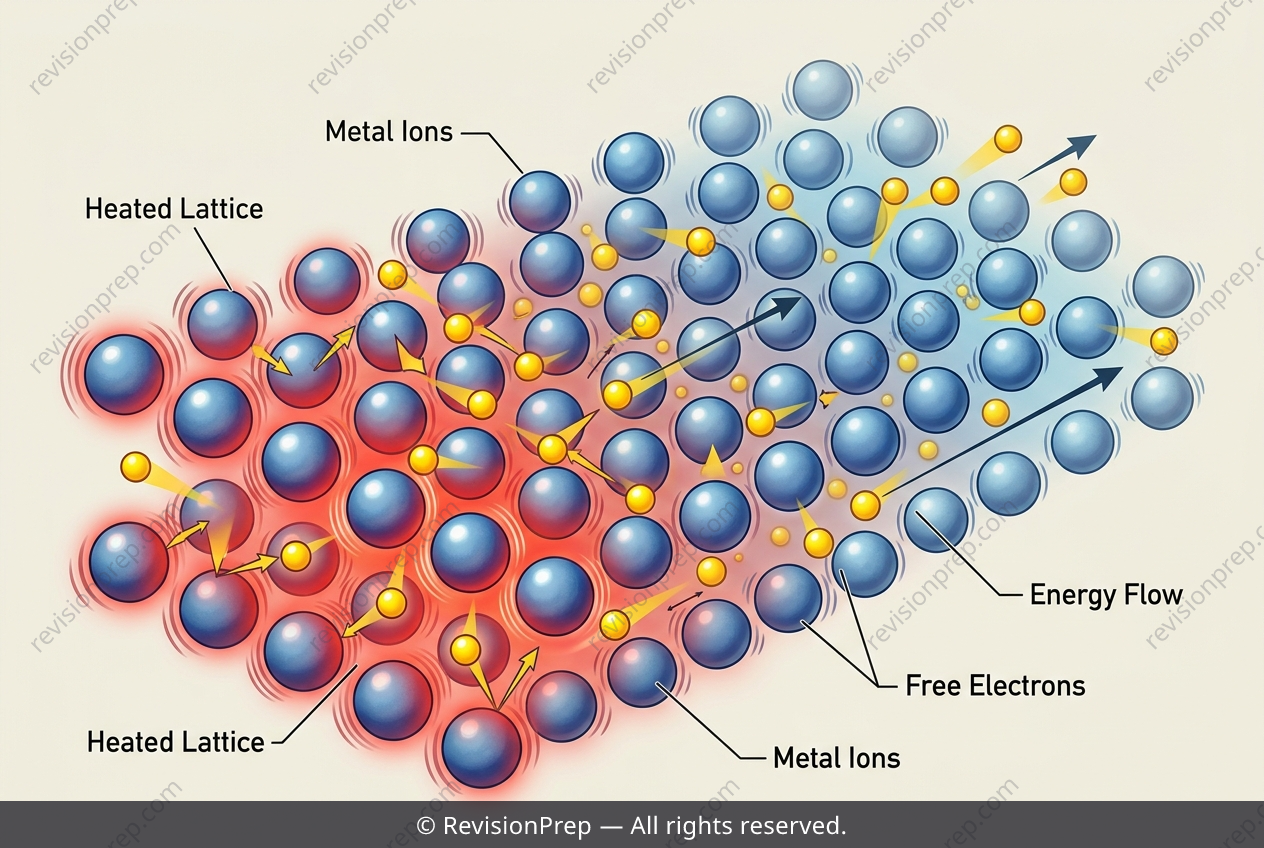
Physics: How Free Electrons Carry Thermal Energy
When you heat one end of a metal rod, the energy doesn’t stay put—it travels, making the far end dangerously hot. This is thermal conduction, the dominant mode of heat transfer in solids, and in metals it’s remarkably efficient. The key lies not in the metal’s lattice alone, but in its free electrons—the delocalised “sea” that also gives metals their electrical conductivity. At the heated end, these electrons gain kinetic energy and move faster. Through successive collisions with neighbouring electrons and lattice ions, they pass this extra energy along the rod, from hot to cold regions. This is why metals conduct heat far better than insulators: the mobile electrons act as rapid energy carriers, far outpacing the slower vibration of the lattice itself. The process follows Fourier’s law, Q/t = -kA(dT/dx), where the thermal conductivity k is large for metals precisely because of this electron-driven mechanism. So when you hold the rod, you’re feeling the cumulative effect of billions of electrons redistributing kinetic energy—not the flame itself, but its energetic signature travelling through the metal.
Start practising IB questions today
150,000+ IB-styled questions, criteria-mapped and instantly accessible.