
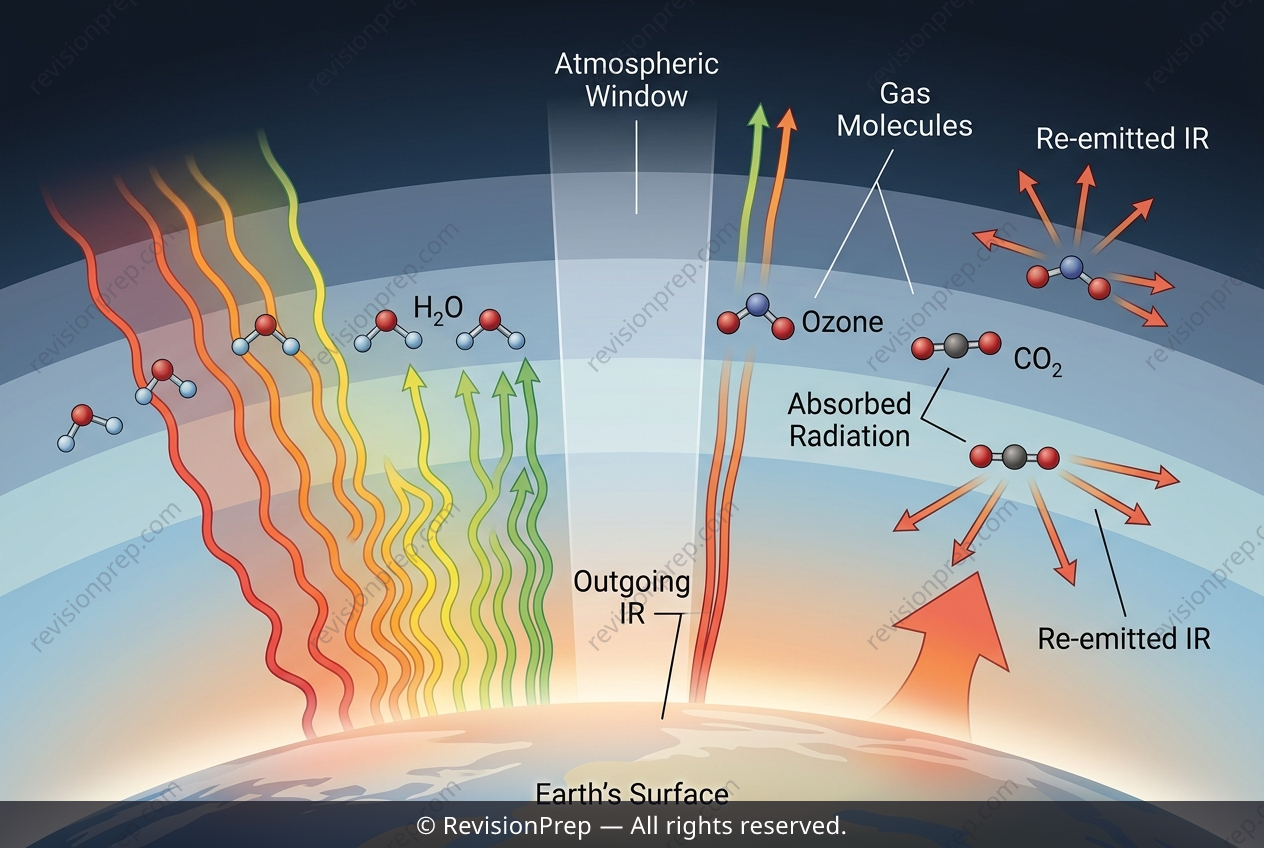
Physics: How Ozone Closes Earth's Infrared Window
The particulate nature of matter explains how the microscopic behaviour of gas molecules governs macroscopic phenomena like Earth’s energy balance. A central idea is that each atmospheric gas absorbs infrared radiation only at specific wavelengths, determined by its molecular vibrations and rotations. This selectivity creates the “atmospheric window,” a spectral gap from roughly 8 to 12 μm where outgoing terrestrial radiation can escape to space, keeping the planet cool. Within this window, however, certain trace gases still intercept energy. Ozone (O₃) possesses a vibrational absorption band centred near 9.6 μm, which partially closes the window by trapping a slice of outgoing radiation. This contrasts with water vapour (H₂O), which absorbs strongly across most infrared wavelengths but less so inside the window, and carbon dioxide (CO₂), whose principal band sits near 15 μm, outside the window. Methane (CH₄) also has bands elsewhere. The relationship between wavelength and energy follows E = hc/λ, so shorter wavelengths carry more energy per photon. Understanding which gas absorbs where—and how those bands overlap with the window—is essential for modelling radiative forcing, climate feedbacks, and the greenhouse effect.
Start practising IB questions today
150,000+ IB-styled questions, criteria-mapped and instantly accessible.