
Physics: How Resonance Reveals a Wave's Wavelength
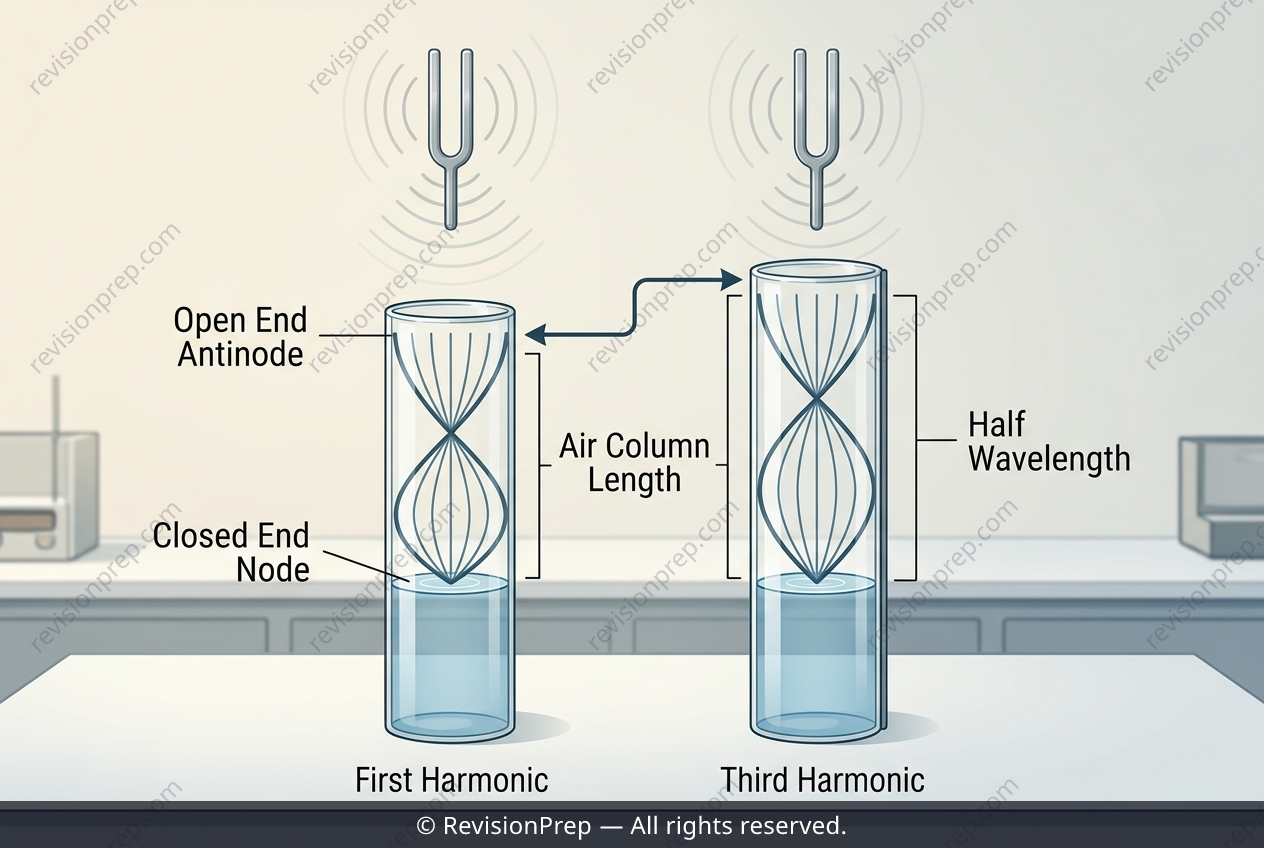
Standing waves in closed-end air columns are a cornerstone of wave behaviour, where sound reflects and interferes to create fixed points of stillness (nodes) and maximum vibration (antinodes). In a pipe closed at one end, the closed end is always a node, while the open end is always an antinode, forcing the system to support only specific wavelengths that “fit” the column’s length. This quantisation is why resonance occurs—when the driving frequency matches one of these natural modes, energy builds up dramatically, producing a loud, sustained tone. The key relationship for a closed pipe is that successive resonance lengths are separated by half a wavelength (λ/2). This arises because moving from one resonance to the next adds exactly one node-antinode pair, which corresponds to half a full wave cycle. In practice, measuring the difference between the first and second resonant lengths—say, at 0.25 m and 0.75 m—directly reveals that spacing, and from it you can deduce the wavelength using the simple formula λ = 2 × (difference in lengths). Understanding this geometric constraint links sound speed, frequency, and pipe dimensions, explaining everything from organ pipes to the pitch of a bottle being filled.
Start practising IB questions today
150,000+ IB-styled questions, criteria-mapped and instantly accessible.