
Physics: How Slit Width Shapes Diffraction Patterns
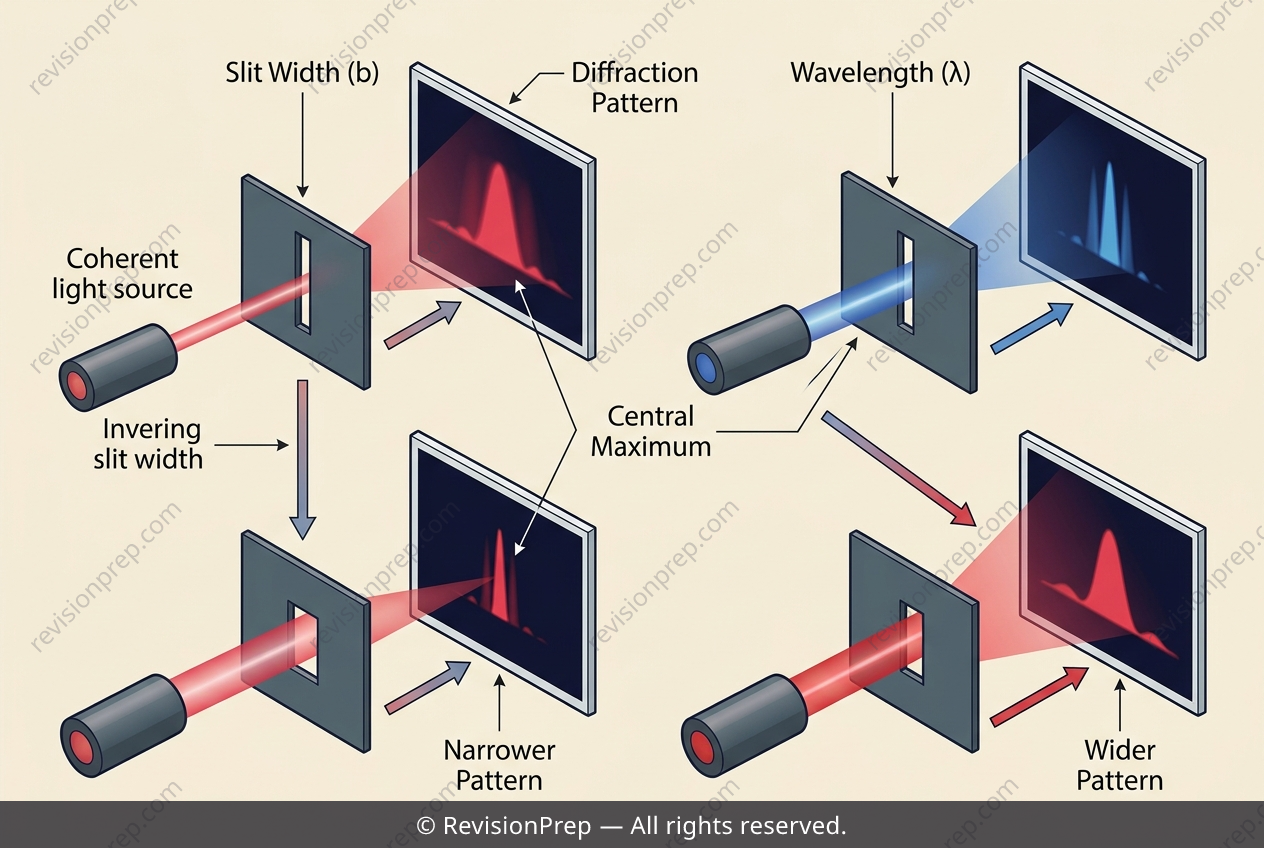
Single-slit diffraction is the spreading and interference of light as it passes through a narrow aperture, producing a central bright band flanked by alternating dark and bright fringes. The pattern’s geometry is governed by the condition b sin θ = mλ, where b is the slit width, λ is the wavelength, and m is a non-zero integer marking each dark minimum. This relationship is the heart of wave behaviour, showing how light’s wave nature responds to confinement. Understanding this topic matters because it explains why sharper images require wider apertures, and why finer details in optical instruments depend on wavelength. The key mechanism is that as b increases, the angular spread of the central maximum shrinks—sin θ for the first minimum becomes smaller—so the whole pattern compresses: the central peak narrows and the secondary fringes pull closer together. Conversely, a smaller λ produces a tighter pattern for the same slit width. The distance from slit to screen, D, then translates these angular positions into physical widths on the screen via y ≈ D sin θ for small angles. Connecting these parameters—b, λ, and D—lets you predict exactly how the pattern’s scale responds to any change in the setup.
Start practising IB questions today
150,000+ IB-styled questions, criteria-mapped and instantly accessible.