
Physics: How Temperature Raises Gas Pressure
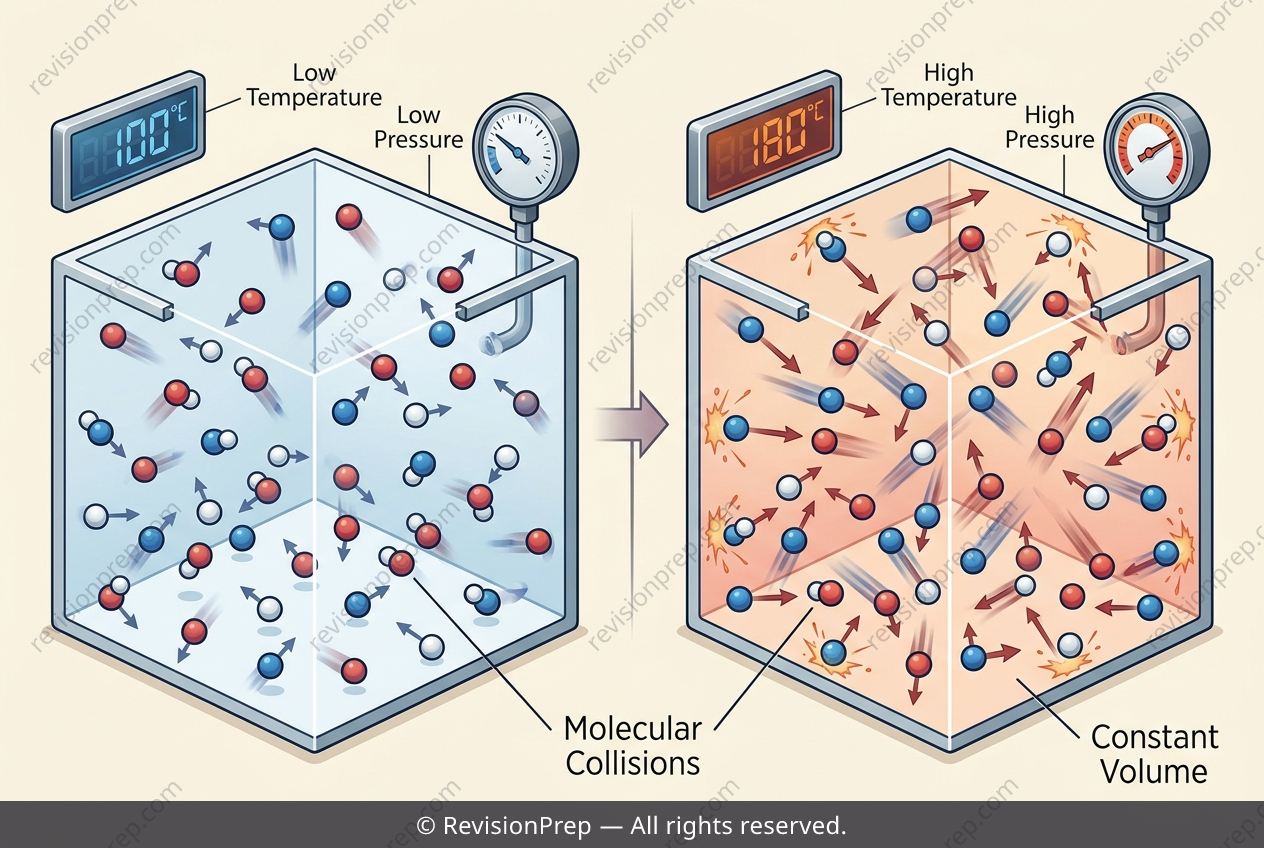
The kinetic model of gases treats a gas as a swarm of tiny, perfectly elastic particles in constant, random motion. For a fixed amount of gas trapped in a rigid container, this model leads to a beautifully simple relationship: pressure is directly proportional to absolute temperature. This is Gay-Lussac’s Law, written as P ∝ T (or P = (nR/V)T), where volume and the number of molecules stay constant. Why does this matter? Because it explains everyday phenomena—from why a bicycle tyre feels harder after a long, hot ride to why aerosol cans warn against heat exposure. The physics lies in the molecular chaos: when temperature rises, the average kinetic energy of the molecules increases, meaning they move faster. Consequently, they strike the container walls both more frequently and with greater force. Each collision transfers more momentum, and the cumulative effect of these harder, more frequent impacts is a measurable rise in pressure. The law connects a macroscopic observable (pressure) directly to the microscopic behaviour of particles, and it allows you to predict new pressures after a temperature change—provided you remember to convert Celsius to kelvin first.
Start practising IB questions today
150,000+ IB-styled questions, criteria-mapped and instantly accessible.