
Physics: Joule Heating and a Rheostat's Limits
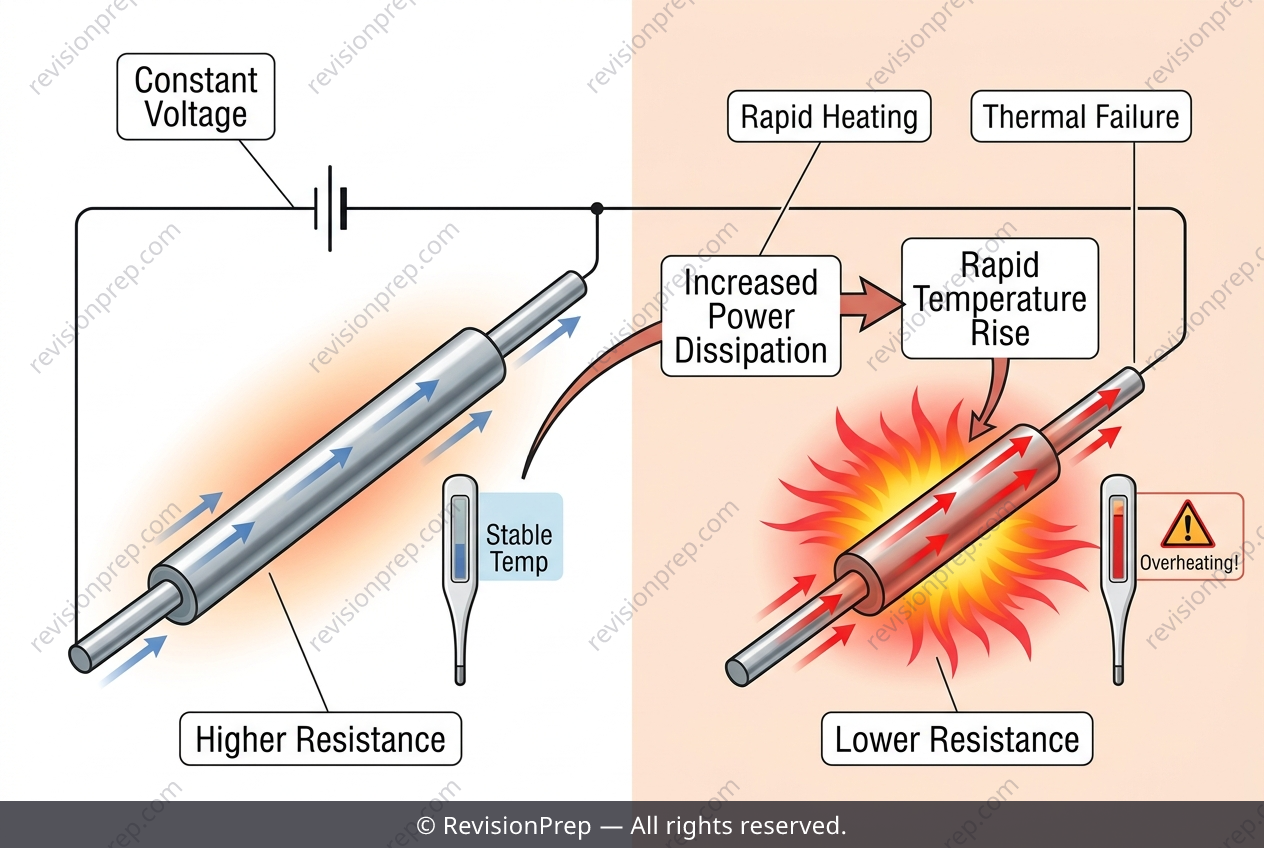
When a current flows through a resistor, electrical energy is converted into heat—a process known as Joule heating. In any real circuit, this isn’t just a side effect; it’s the fundamental link between electrical power and thermal behaviour. For a component like a rheostat, which is simply a long wire of uniform cross-section, the resistance depends directly on how much of that wire is in the circuit. Because the voltage across the rheostat is fixed, the power dissipated is given by P = V²/R, meaning that as the resistance drops (by shortening the active length), the power output rises sharply. This relationship becomes critical in thermal management. Halving the wire’s length halves its resistance, which doubles the power dissipated—but it also halves the mass of material available to absorb that heat. The rate of temperature rise, ΔT/Δt = P/(mc), therefore scales dramatically: double the power into half the mass yields roughly four times the heating rate. In industrial chargers, this can push a wire past its thermal limit, causing failure. Understanding how resistance, power, and heat capacity interact is essential for designing components that survive real operating conditions.
Start practising IB questions today
150,000+ IB-styled questions, criteria-mapped and instantly accessible.