
Physics: Methane's Punch — GWP and Time Horizons
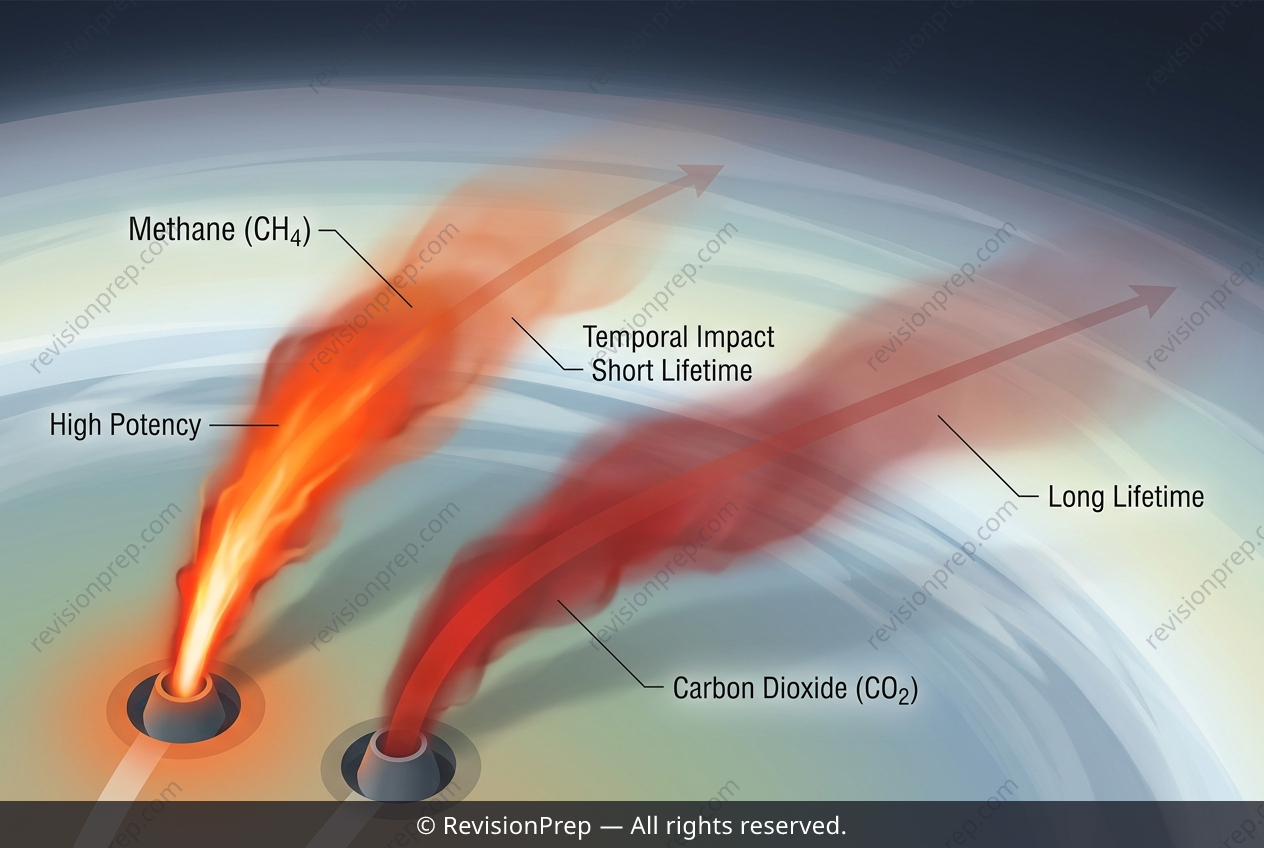
Methane doesn’t linger like carbon dioxide, but it hits far harder while it’s here. That contrast is the heart of the particulate nature of matter when applied to climate physics: different gases interact with radiation in distinct ways, and their warming impact depends on both their molecular structure and their atmospheric lifetime. The global warming potential (GWP) metric exists to translate this messy reality into a single comparable number—specifically, the mass of CO₂ that would produce the same cumulative radiative forcing over a chosen time horizon. The key relationship is straightforward: CO₂-equivalent emissions equal the mass of methane emitted multiplied by its GWP. But the choice of time horizon changes the story dramatically. Methane’s 100-year GWP is 28, yet its 20-year GWP is roughly 80—because methane absorbs infrared intensely but oxidises within about 12 years, while CO₂ accumulates for centuries. Averaging over a century dilutes methane’s short-term punch. This is why short-lived but potent gases matter for near-term warming rates, even though CO₂ remains the dominant long-term driver. Understanding this trade-off—between intensity and persistence—is essential for evaluating real-world emission reduction strategies.
Start practising IB questions today
150,000+ IB-styled questions, criteria-mapped and instantly accessible.