
Physics: Reading a Sound Wave's Secret Trace
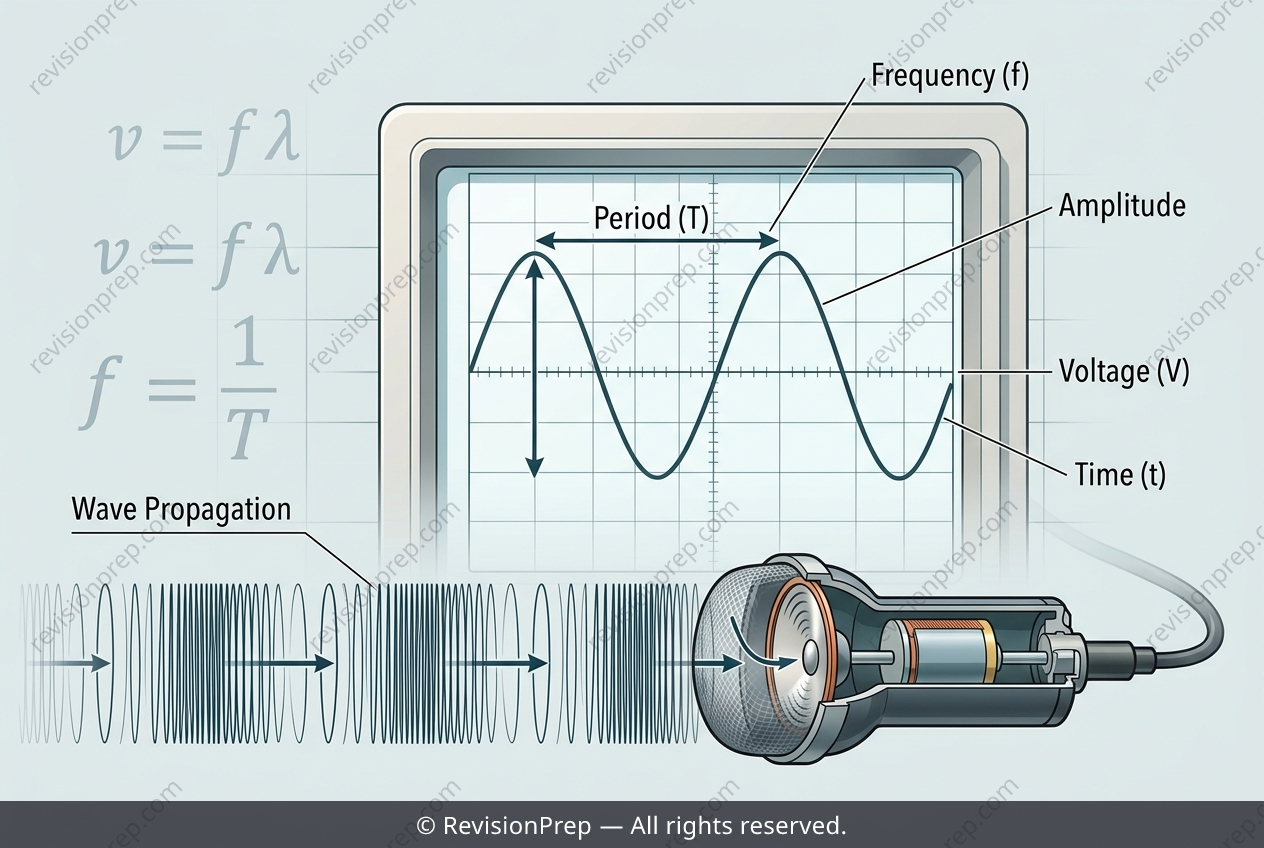
When a sound wave travels through a tube, its characteristics—amplitude, period, and wavelength—can be captured electronically and displayed as a trace on an oscilloscope. This topic, Wave Behaviour, focuses on how to read such traces and translate the visual data into measurable physical quantities. The core relationship at play is v = fλ, which links the wave’s speed (v) to its frequency (f) and wavelength (λ), but before you can apply that, you must extract f and amplitude from the time-base and voltage settings of the scope. The amplitude is determined by the peak-to-peak height divided by two, since the trace swings symmetrically above and below the equilibrium line. Meanwhile, the horizontal distance between consecutive peaks gives the period (T), from which frequency is simply the reciprocal. Once you have f, the wavelength follows from the speed of sound. Understanding how these measurements interconnect is crucial: changing the frequency alters the period on the trace, while amplitude remains independent. Moreover, recognising that wavelength is often inferred rather than directly measured highlights a key limitation in experimental physics—one that can be addressed by alternative setups like dual-microphone phase comparison or resonance tubes.
Start practising IB questions today
150,000+ IB-styled questions, criteria-mapped and instantly accessible.