
Physics: SHM - Where Motion, Energy and Maths Connect
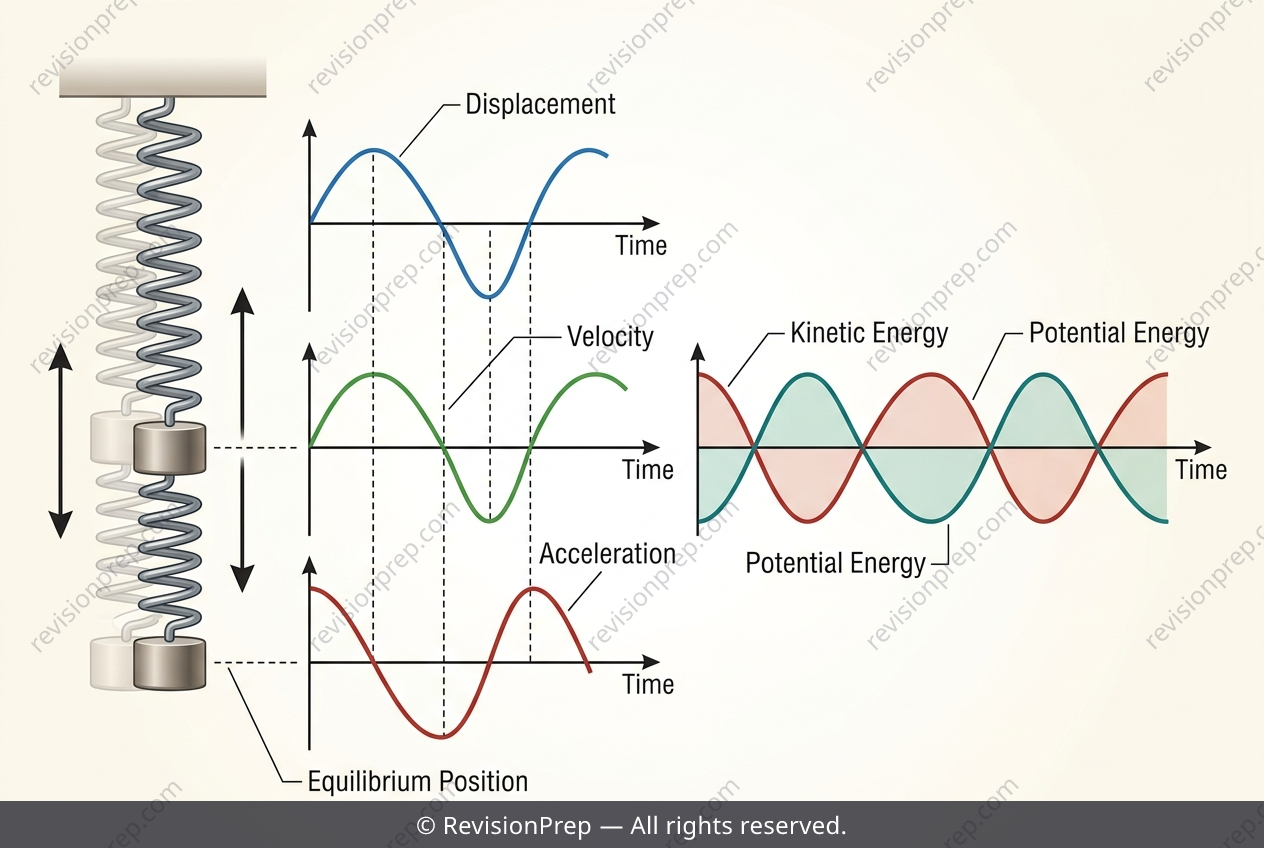
Simple Harmonic Motion (SHM) is the archetype of all oscillating systems—from a mass on a spring to the swing of a pendulum—where the restoring force is directly proportional to displacement and always acts toward equilibrium. In this Physics SL question, you’ll track a 0.25 kg mass bobbing with a period of 1.2 s and an amplitude of 0.08 m, starting at its maximum positive displacement. The heart of SHM lies in its cyclic exchange of energy: the system continually converts kinetic energy into elastic potential energy and back, while the total mechanical energy remains constant. To describe this motion precisely, we use sinusoidal functions. The displacement follows x = x₀ cos(ωt), where ω = 2π/T is the angular frequency. Velocity and acceleration are then derived as time derivatives: v = –ωx₀ sin(ωt) and a = –ω²x₀ cos(ωt). Notice how acceleration always points opposite to displacement—that’s the signature of SHM. The spring constant k links to the period via T = 2π√(m/k), and the total energy is ½kx₀². At any instant, the sum of elastic potential energy (½kx²) and kinetic energy equals this total, allowing you to find one if you know the other. Finally, changing k alters ω, which directly scales both maximum velocity (ωx₀) and maximum acceleration (ω²x₀), showing how stiffness governs the system’s responsiveness.
Start practising IB questions today
150,000+ IB-styled questions, criteria-mapped and instantly accessible.