
Physics: The Energy Link Between Speed and Amplitude
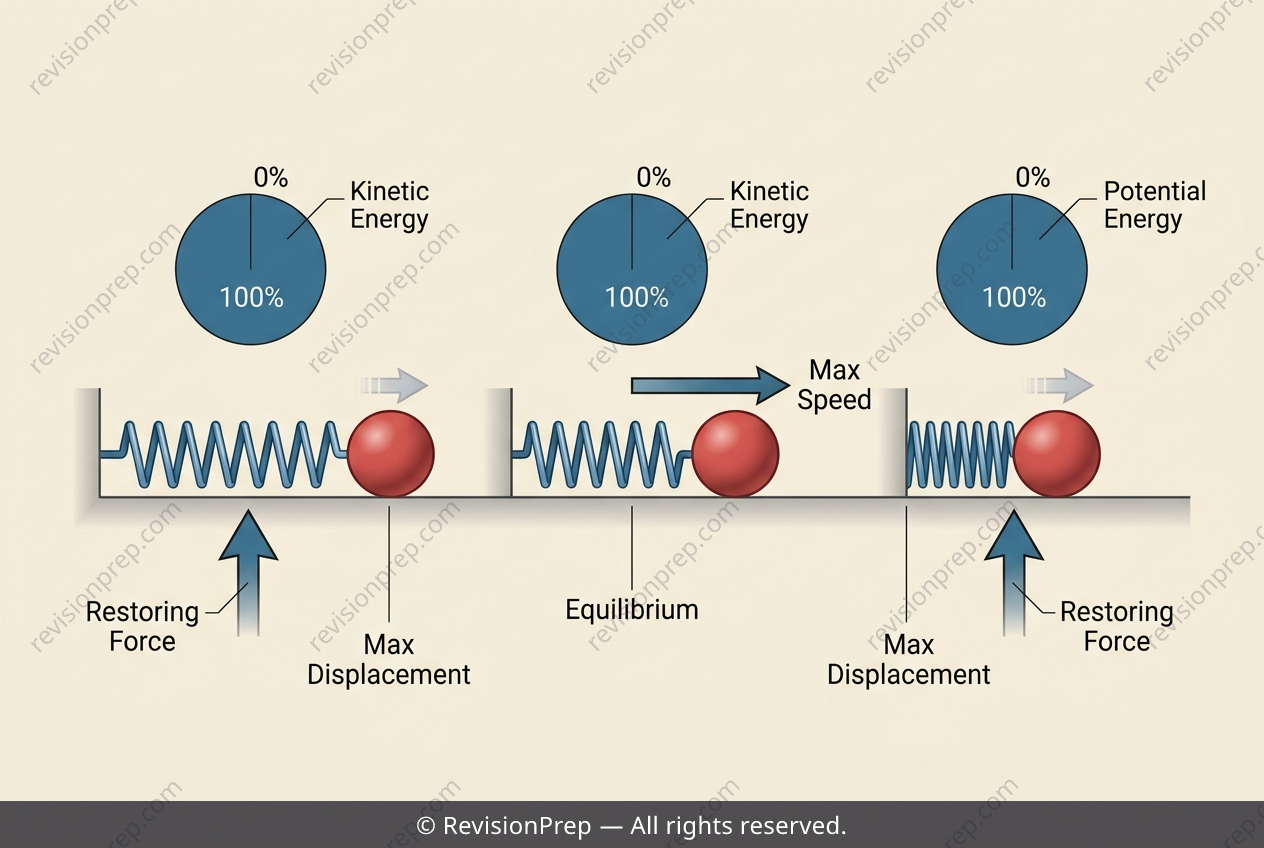
Simple Harmonic Motion (SHM) is the archetype of repetitive, oscillatory behaviour—think of a mass on a spring, a pendulum’s gentle swing, or the vibration of a guitar string. At its heart lies a deceptively simple idea: the restoring force is proportional to displacement, pulling the particle back toward equilibrium. But the kinematics that emerge from this rule are rich, revealing a continuous exchange between motion and position. In SHM, the particle’s speed is not constant; it peaks as it races through the equilibrium point (where displacement is zero) and falls to zero at the turning points, where displacement equals the amplitude, ±A. This inverse relationship between speed and displacement is governed by the angular frequency, ω, which sets the pace of the oscillation. Crucially, SHM is a masterclass in energy conservation. The total mechanical energy remains fixed, shuttling back and forth between kinetic energy (maximum at equilibrium) and potential energy (maximum at the extremes). This energy can be expressed either through the maximum speed, using E = ½mv²max, or through the amplitude and angular frequency, via E = ½mω²A². Because vmax = ωA, these two forms are perfectly equivalent—a single elegant link that ties together the particle’s mass, its frequency of oscillation, and the spatial extent of its motion, allowing you to predict any one quantity from the others.
Start practising IB questions today
150,000+ IB-styled questions, criteria-mapped and instantly accessible.