
Physics: The Hidden Architecture of Standing Waves
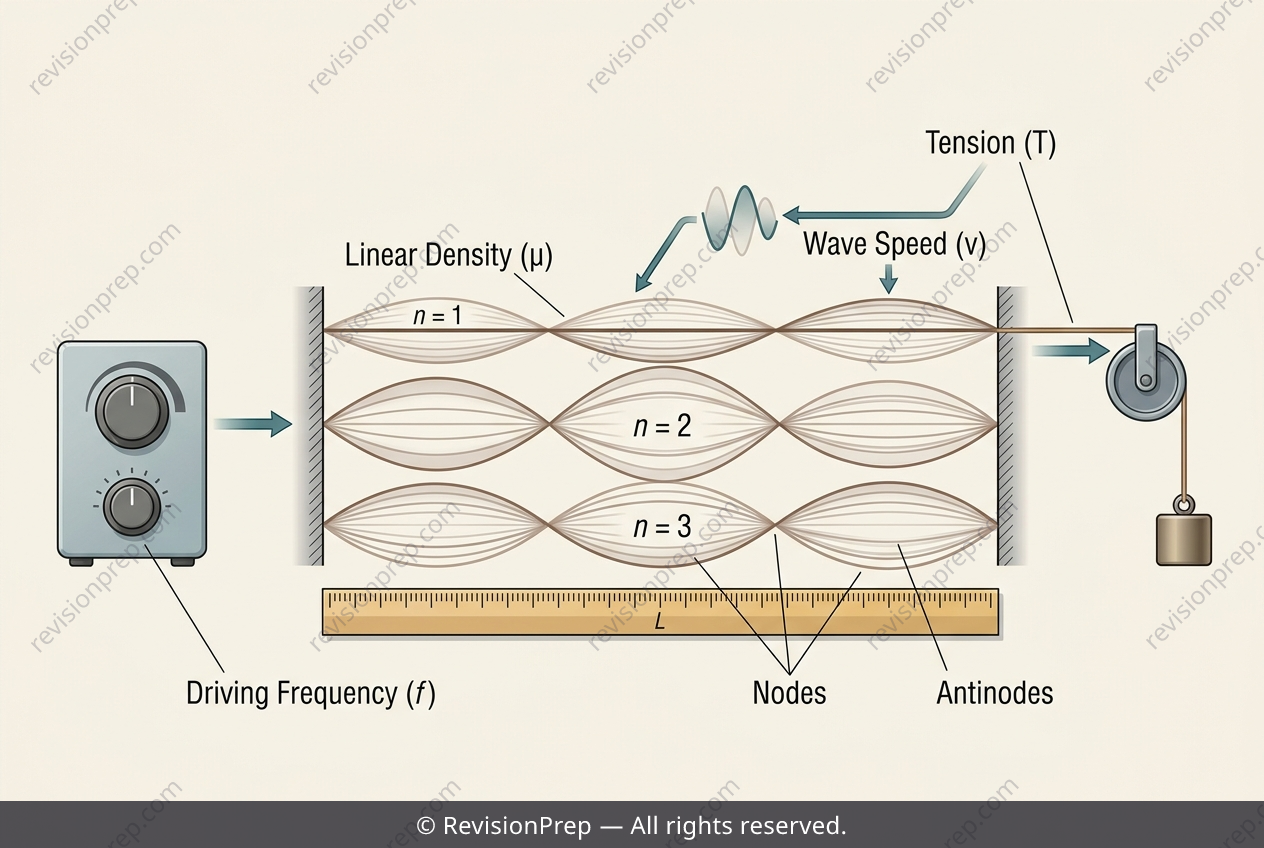
Standing waves are the hidden architecture of musical instruments, bridges, and even quantum wells—patterns where energy appears frozen in place, yet every point vibrates at the same frequency. In Physics SL, this topic asks you to connect the physical properties of a string (its tension, mass per unit length, and length) to the discrete frequencies at which it “likes” to vibrate. When a string is fixed at both ends, only certain wavelengths fit perfectly, giving rise to harmonics: the nth harmonic has n antinodes and satisfies L = nλ/2. This relationship is the backbone of the problem, linking the spatial pattern directly to the wave speed via v = fλ. The real insight comes when you realise that the wave speed itself is not arbitrary—it is set by the medium through v = √(T/μ). Once you know v, you can predict every natural frequency (fₙ = nv/2L), and resonance occurs when a driving frequency matches one of these. Here, the driving frequency starts above the first two harmonics, so the first observed standing wave with three antinodes corresponds to n = 3. The beauty is that a small discrepancy between the calculated and observed wave speeds can be traced back to the uncertainty in tension, showing how tightly theory and measurement are interwoven.
Start practising IB questions today
150,000+ IB-styled questions, criteria-mapped and instantly accessible.