
Physics: The Hidden Link Between Speed and Displacement
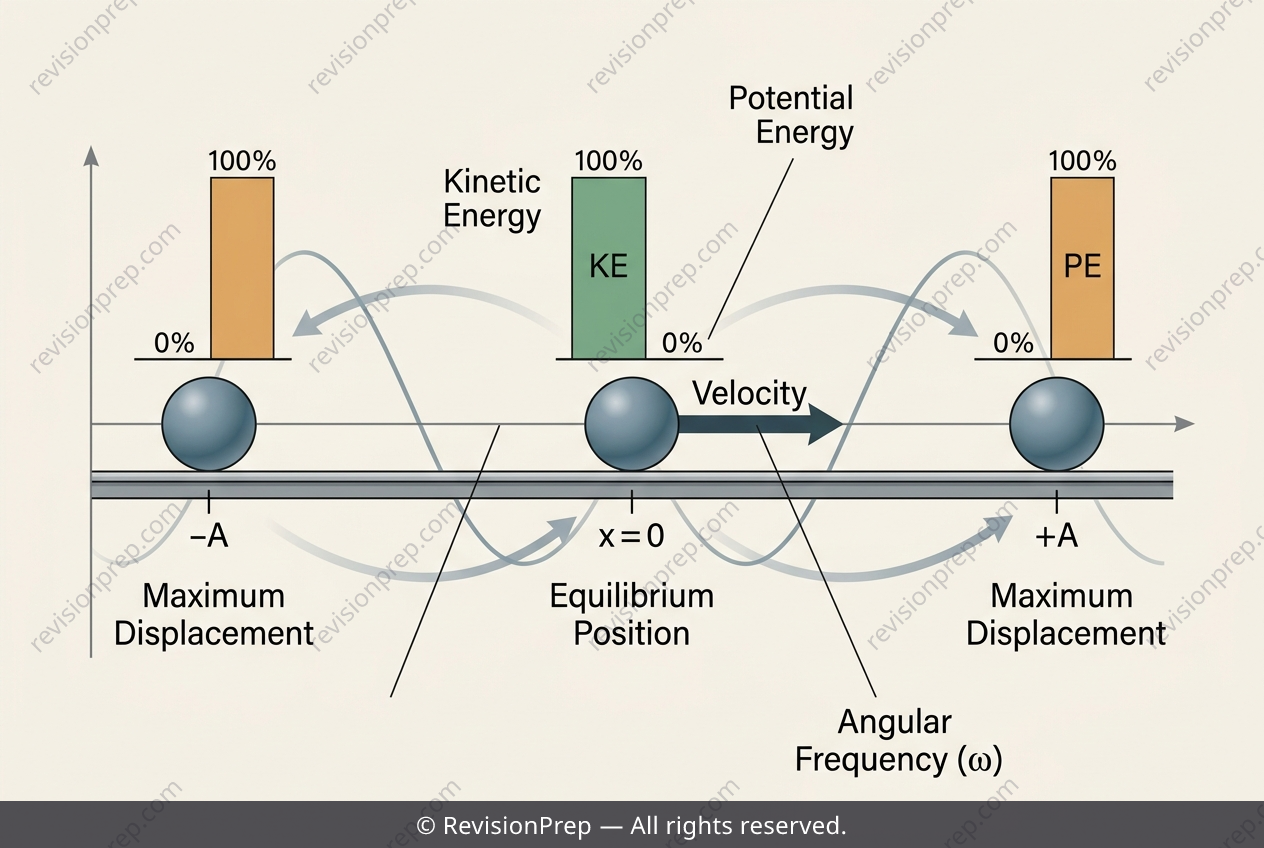
Simple Harmonic Motion (SHM) is the archetype of all oscillating systems—from a mass on a spring to the vibrations of a guitar string—and it is defined by a single, elegant condition: the restoring force is proportional to displacement and always acts toward equilibrium. This produces a motion where position, velocity, and acceleration are locked in a sinusoidal dance, governed by the angular frequency ω. The relationship v = ±ω√(A² − x²) captures the heart of SHM dynamics, linking the object’s speed at any displacement to the amplitude A and the frequency of the oscillation. What makes SHM so powerful is its built-in energy conservation. As the object moves, energy continuously shuttles between kinetic and potential forms, never leaving the system. At the equilibrium position (x = 0), all energy is kinetic—speed is maximum—while potential energy is zero. At maximum displacement (x = A), the object momentarily stops: kinetic energy is zero, and all energy is stored as potential. The formula above emerges directly from this conservation: at any intermediate point, the sum of kinetic energy (½mω²(A² − x²)) and potential energy (½mω²x²) equals the constant total energy ½mω²A². Understanding this energy exchange lets you predict amplitude, speed, and position anywhere in the cycle—without ever needing to track forces explicitly.
Start practising IB questions today
150,000+ IB-styled questions, criteria-mapped and instantly accessible.