
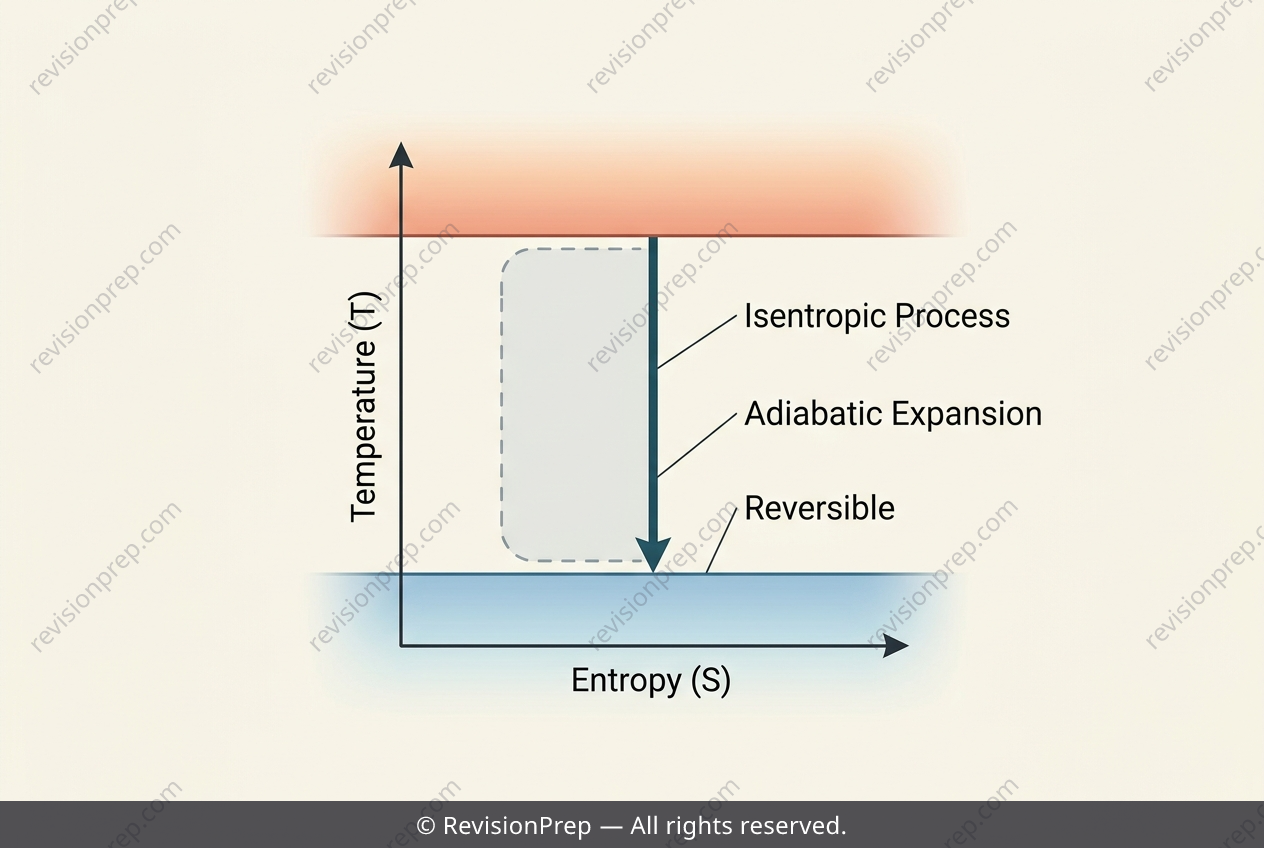
Physics: The Isentropic Process in Carnot Engines
In the study of thermodynamics, few ideas are as elegant as the isentropic process—a transformation where entropy, the measure of a system’s disorder, remains perfectly unchanged. For an IB Physics HL student, this concept is the quiet engine behind the efficiency of ideal heat engines, particularly the Carnot cycle, which sets the theoretical limit for converting heat into work. The key to understanding isentropic behaviour lies in its two strict conditions: the process must be both reversible and adiabatic (meaning no heat is exchanged with the surroundings). In a Carnot engine, the turbine expansion of steam is modelled exactly this way. Since entropy change (ΔS) is defined by the heat transferred divided by the absolute temperature (ΔS = Q/T), and an adiabatic process has Q = 0, the entropy change must be zero. This does not mean the steam’s temperature or pressure stays constant—it expands and cools—but rather that its microscopic disorder, when viewed as a whole, is conserved. This principle connects directly to the second law: while real turbines are irreversible and generate entropy, the idealised Carnot engine treats each stroke as a frictionless, perfectly balanced dance, where no energy is lost to randomness, only converted into useful work.
Start practising IB questions today
150,000+ IB-styled questions, criteria-mapped and instantly accessible.