
Physics: The Limits of Simple Harmonic Motion
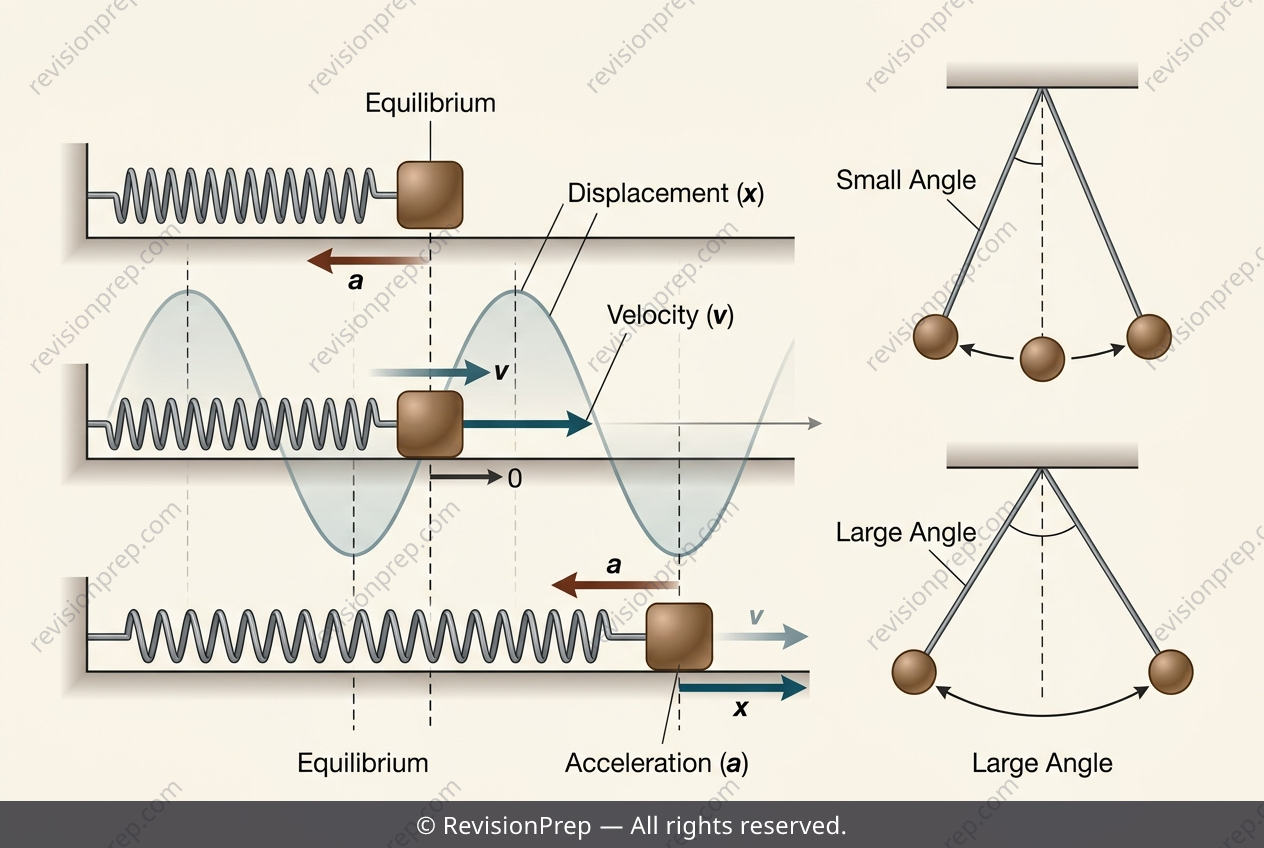
Simple harmonic motion (SHM) is the archetype of all oscillating systems—from a pendulum’s gentle swing to the vibration of atoms in a crystal. At its heart lies a single, elegant condition: the restoring force must be proportional to displacement and directed opposite to it. This gives rise to the defining equation a = −ω²x, where ω is the angular frequency and x is the displacement from equilibrium. The negative sign is not a formality; it is the physical guarantee that acceleration always pulls the particle back toward the centre, never away from it. What makes SHM so powerful is that its kinematics are fully determined by just two parameters: amplitude and angular frequency. From the displacement equation x(t) = x₀cos(ωt + φ), you can extract maximum speed (vmax = ωx₀) and maximum acceleration (amax = ω²x₀), which occur at equilibrium and at the extremes, respectively. However, this clean model rests on a crucial assumption—that the restoring force remains linear. When a pendulum’s amplitude grows beyond roughly 10°, the approximation sinθ ≈ θ breaks down, introducing a fractional error in the restoring force and making the period amplitude-dependent. Recognising this boundary between idealised SHM and real anharmonic motion is essential for correctly applying the model to physical systems.
Start practising IB questions today
150,000+ IB-styled questions, criteria-mapped and instantly accessible.