
Physics: The Molecular Logic of Boyle's Law
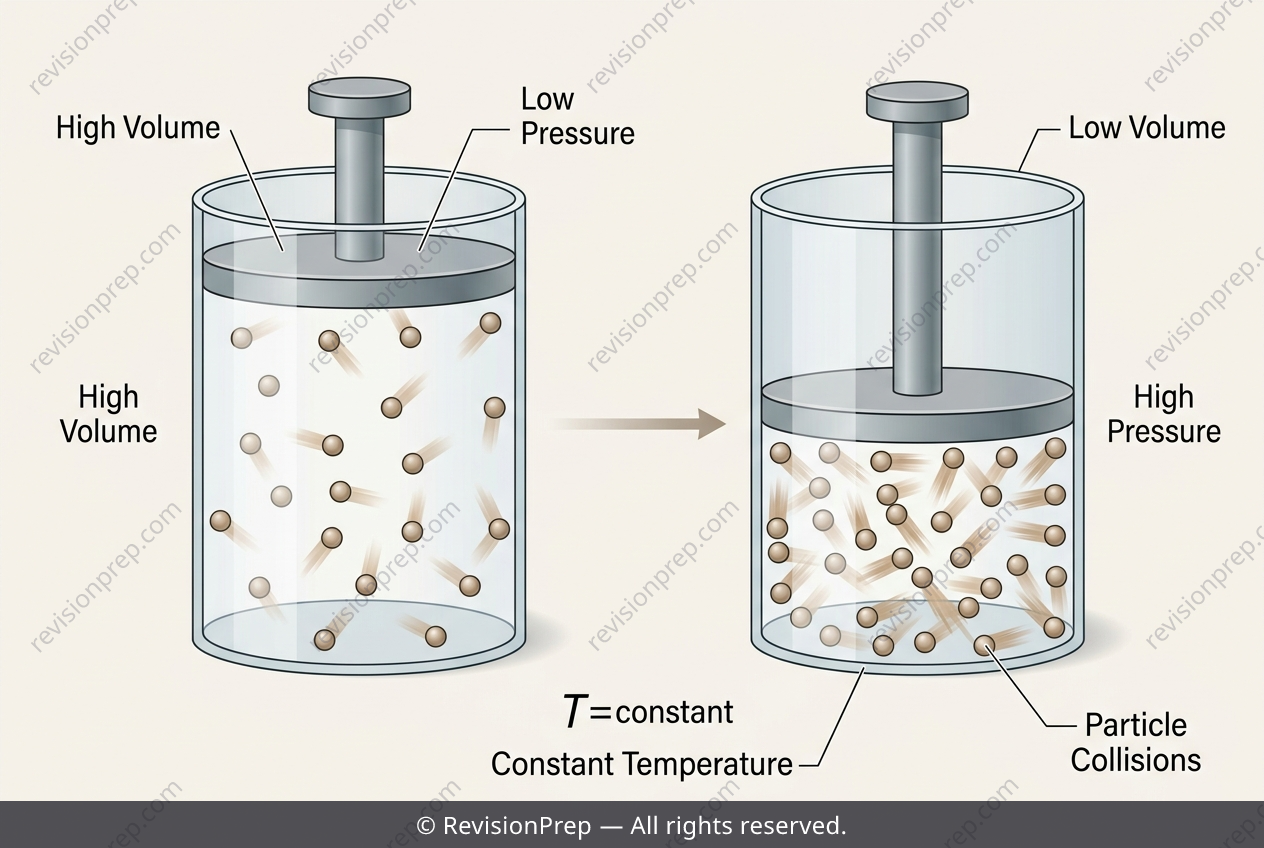
Boyle’s law is a cornerstone of the kinetic theory of gases, describing how a fixed amount of gas responds when its volume changes. At its heart, the law states that for a fixed mass of an ideal gas held at constant temperature, pressure is inversely proportional to volume—written simply as P ∝ 1/V, or more practically as P₁V₁ = P₂V₂. This relationship emerges from the microscopic picture of gas particles: as the container shrinks, particles strike the walls more frequently, increasing the force per unit area, provided the average kinetic energy (and thus temperature) stays unchanged. Understanding Boyle’s law matters because it links the invisible, random motion of molecules to a measurable, macroscopic property like pressure. The two conditions—constant mass and constant temperature—are not technicalities; they define the very regime where the inverse proportionality holds. If gas leaks out or heat is exchanged, the simple product P×V no longer stays constant. In a typical investigation using a sealed syringe, pushing the plunger slowly ensures temperature remains near ambient, allowing you to predict the new pressure directly from the initial and final volumes. This single equation thus bridges experimental observation and molecular theory, making it a powerful tool for analysing real gas behaviour under controlled conditions.
Start practising IB questions today
150,000+ IB-styled questions, criteria-mapped and instantly accessible.