
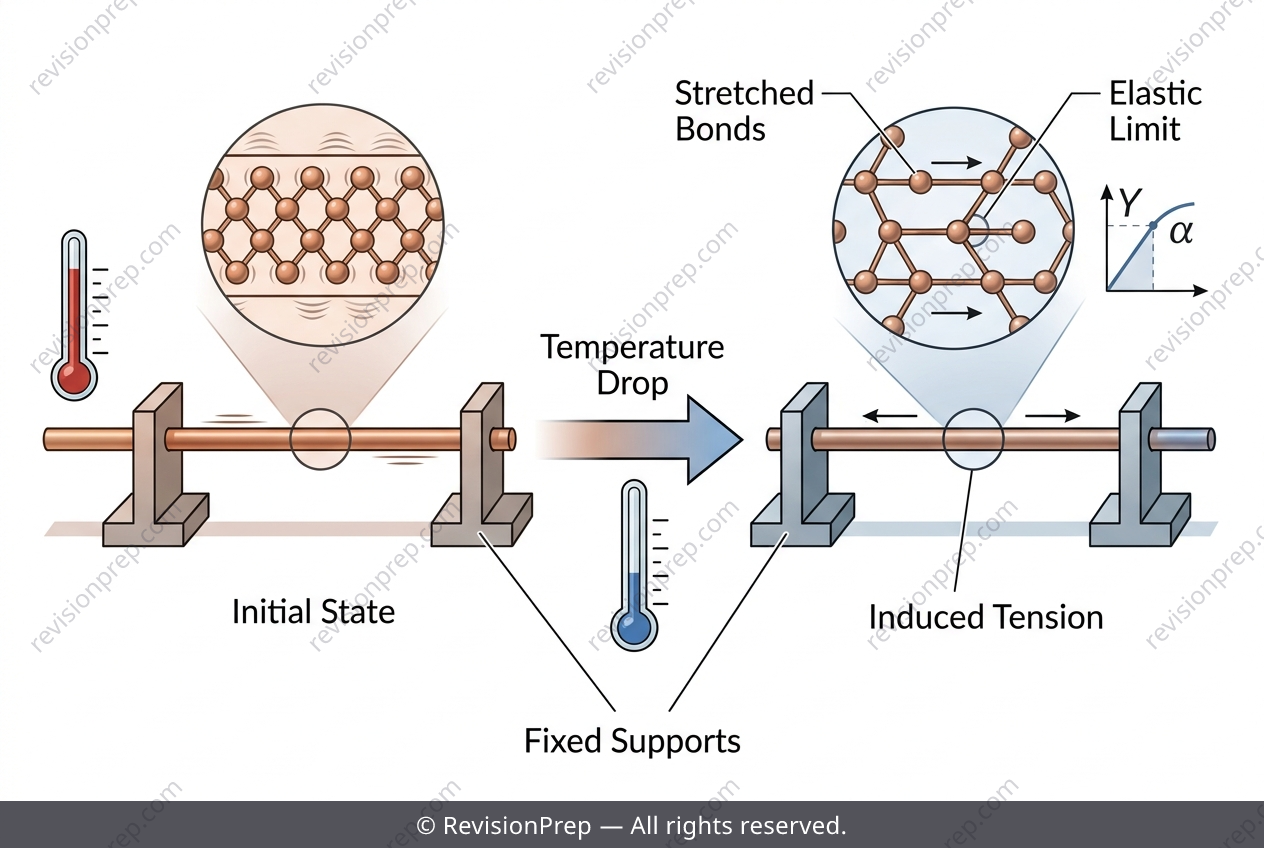
Physics: Thermal Stress in a Constrained Wire
When a material is physically prevented from changing size as its temperature shifts, it experiences a hidden but powerful consequence: internal stress. This is the essence of constrained thermal deformation, a concept that bridges thermal physics and mechanics. In this case, a copper wire stretched between two fixed points cannot contract when cooled, so the natural tendency to shrink is converted into additional tension within the wire itself. The key relationship at play is σ = YαΔT, where the thermal strain (αΔT) is multiplied by the material’s Young modulus (Y) to yield the induced stress. This stress, when multiplied by the wire’s cross-sectional area, gives the extra force added to the initial tension. Meanwhile, if the wire were free, it would simply shorten by ΔL = αL₀ΔT—a direct measure of its unconstrained response. Crucially, the total stress must be compared to the material’s yield stress; exceeding this limit means the wire permanently deforms, losing its elastic integrity. Understanding this interplay between thermal expansion, mechanical constraint, and material limits is fundamental to designing structures that endure temperature changes without failure.
Start practising IB questions today
150,000+ IB-styled questions, criteria-mapped and instantly accessible.