
Physics: Tracking Entropy Through Phase Changes
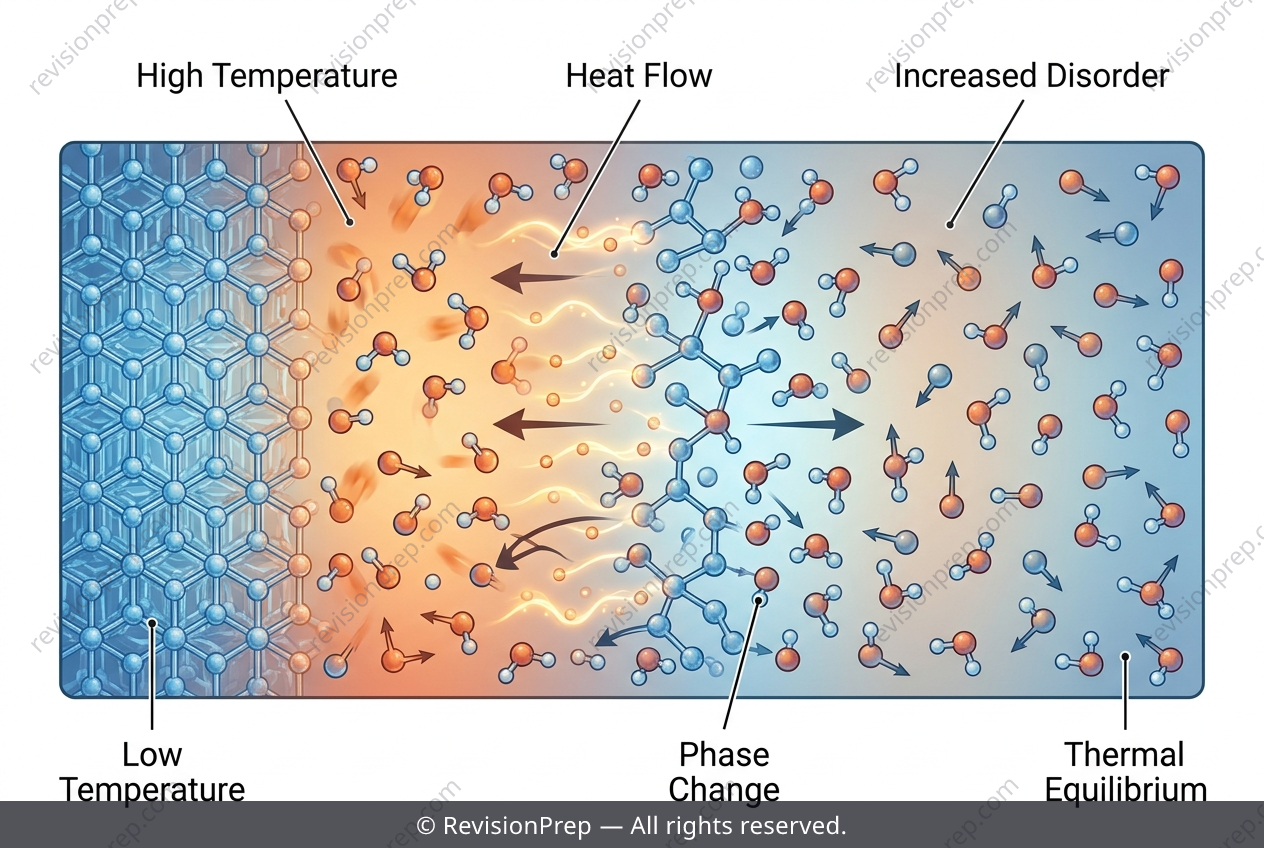
Entropy is often introduced as a measure of disorder, but in thermal physics it is far more precise: it quantifies the energy spreading that occurs whenever heat flows between objects at different temperatures. For an IB Physics HL student, the particulate nature of matter becomes tangible when you track entropy changes during phase transitions and thermal equilibration—because here, energy dispersal happens in two distinct ways: through the breaking of intermolecular bonds at a constant temperature, and through the temperature change of the substances themselves. In a system like an ice block melting into warmer water, the total entropy change is the sum of three contributions: the entropy gained by the ice as it melts (given by the latent heat divided by the melting temperature, ΔS = mL/T), the entropy gained by the melted ice warming from 0°C to the final equilibrium temperature (using ΔS = mc ln(Tf/Ti)), and the entropy lost by the original warm water cooling to that same final temperature. The key insight is that entropy is a state function—its total change depends only on the initial and final states, not the path. Because the container is insulated, no entropy is exchanged with the surroundings, so the system’s total entropy change must be positive (or zero for a reversible process). Here, the ice’s melting and warming produce a large positive contribution, while the warm water’s cooling gives a negative one; the net result reflects the irreversibility of heat flowing from hot to cold. Understanding this balance—where each term comes from and why the final temperature matters—is central to mastering entropy in phase
Start practising IB questions today
150,000+ IB-styled questions, criteria-mapped and instantly accessible.