
Physics: What Redshift Reveals - and What It Hides
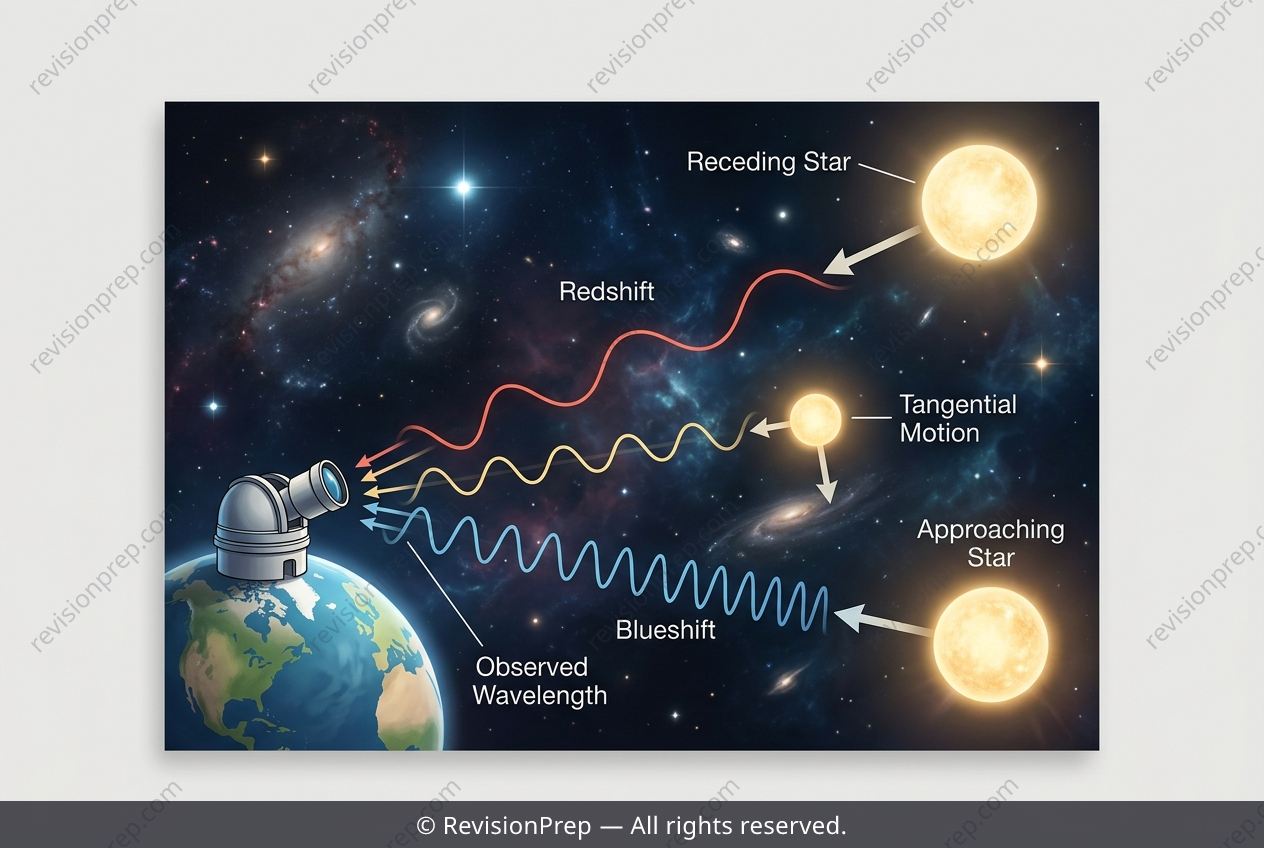
When a source of light moves relative to an observer, the observed wavelength shifts—a phenomenon known as the Doppler effect. For electromagnetic waves, this shift is governed by the simple relationship Δλ/λ₀ = v/c, where Δλ is the change in wavelength, λ₀ is the rest wavelength, v is the relative speed along the line of sight, and c is the speed of light. This formula is the key to unlocking the motion of distant celestial objects, making it a cornerstone of astrophysics and a classic application of wave behaviour. The concept matters because it allows astronomers to measure how fast stars and galaxies are moving toward or away from us, directly informing our understanding of cosmic expansion. In the case of a receding star, each successive wave crest is emitted from a slightly farther position, stretching the distance between crests and thus increasing the observed wavelength—a redshift. However, the Doppler shift only reveals the radial component of velocity (motion along our line of sight). Any transverse motion, moving across the sky, produces no shift in wavelength, meaning the full three-dimensional velocity of a star cannot be deduced from Doppler data alone; proper motion measurements are required to complete the picture.
Start practising IB questions today
150,000+ IB-styled questions, criteria-mapped and instantly accessible.