
Physics: Why Closed Pipes Skip Even Harmonics
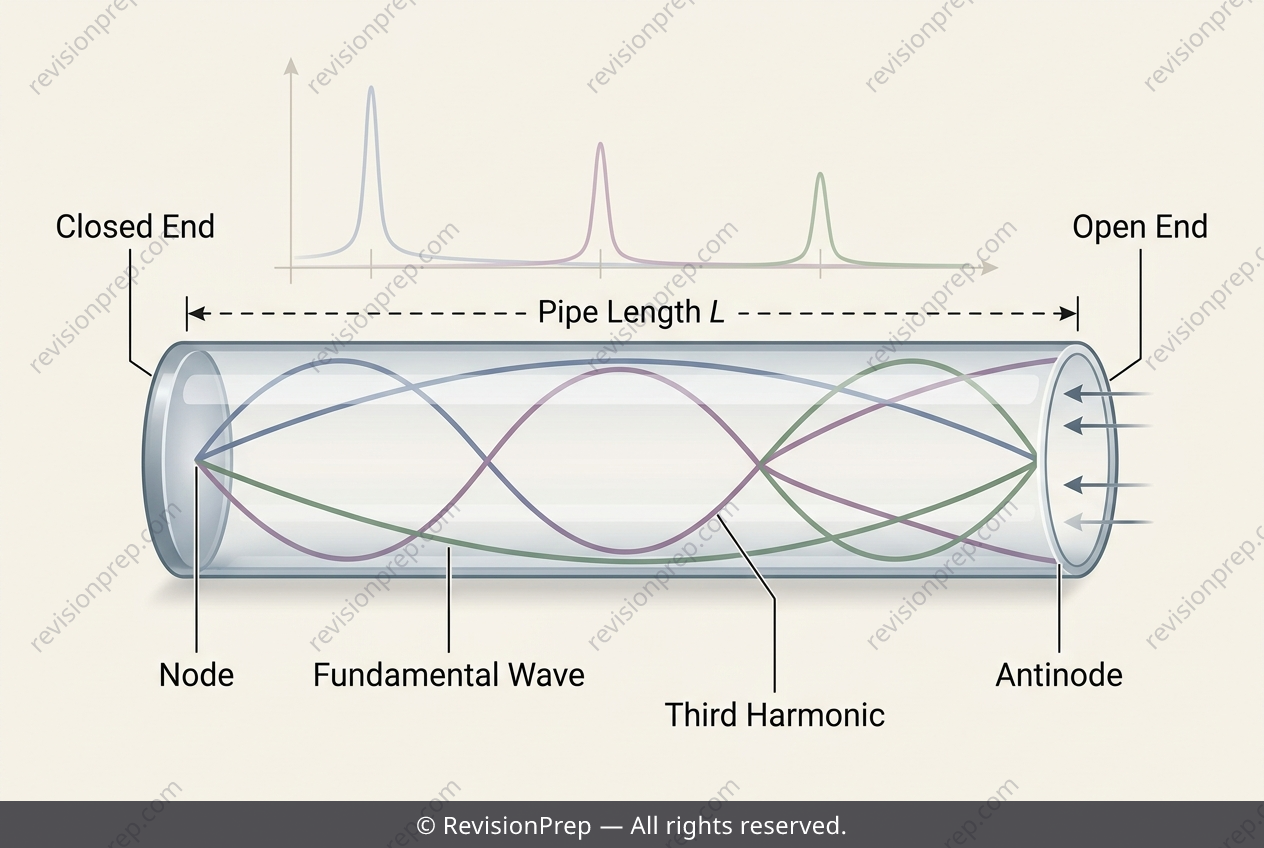
Standing waves in pipes are a beautiful demonstration of how boundary conditions shape the behaviour of sound. In a pipe closed at one end and open at the other, the closed end forces a displacement node (air molecules cannot move), while the open end creates an antinode (maximum movement). This asymmetry means that only certain wavelengths can fit into the pipe, giving rise to a specific set of resonant frequencies known as harmonics. For a closed-open pipe, the fundamental (first harmonic) has a wavelength equal to four times the pipe length, λ = 4L. Because the pattern must always have a node at the closed end and an antinode at the open end, only odd-numbered harmonics are possible: the third, fifth, seventh, and so on. The general relationship is fₙ = nv/(4L), where n is an odd integer (1, 3, 5…), v is the speed of sound, and L is the pipe length. This formula connects the physical geometry of the pipe to the pitch you hear, explaining why a clarinet (closed at one end) produces a different overtone series than a flute (open at both ends). Understanding this pattern helps you predict frequencies without memorising every case—just identify the boundary conditions, count the quarter-wavelengths, and apply the formula.
Start practising IB questions today
150,000+ IB-styled questions, criteria-mapped and instantly accessible.