
Physics: Why Only Transverse Waves Can Polarise
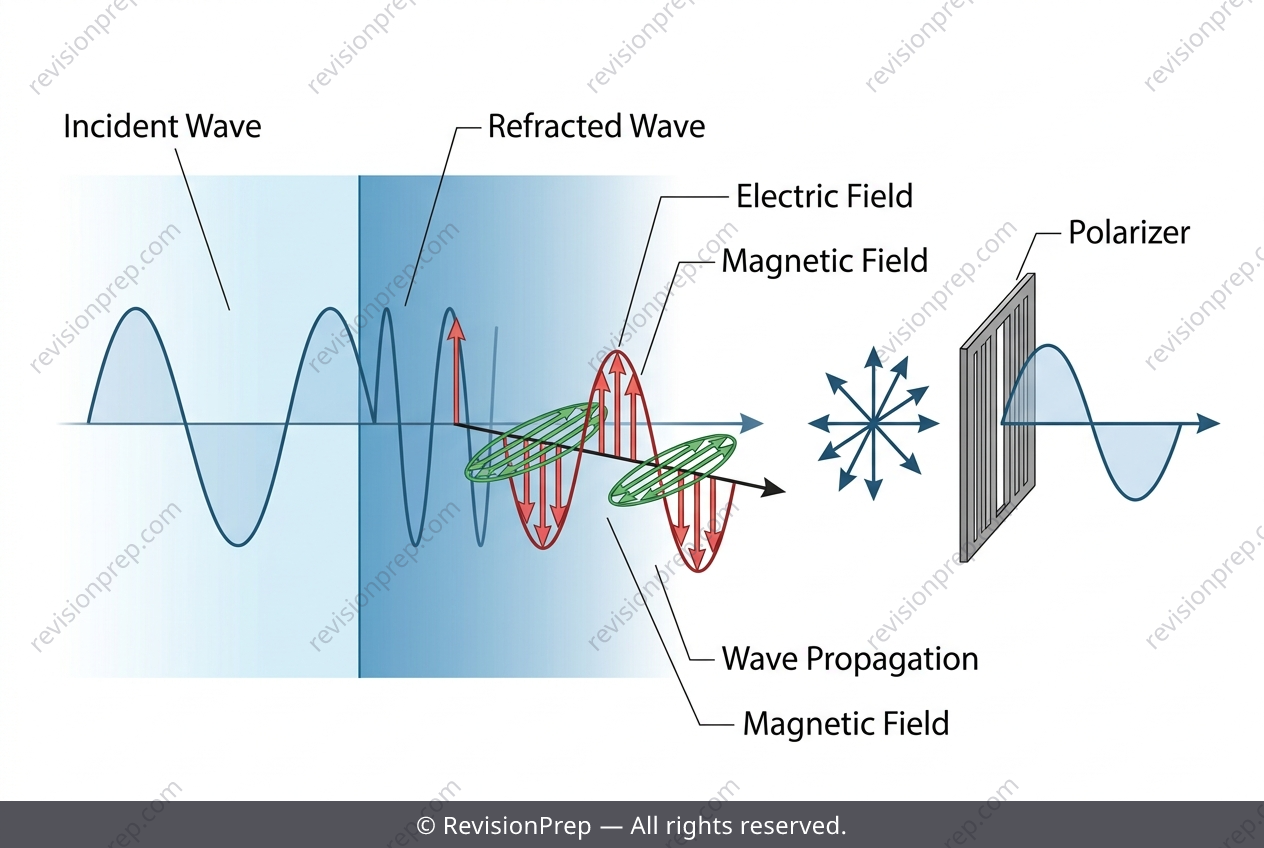
When light crosses from a vacuum into a glass block, its speed drops, yet its frequency remains stubbornly constant. This single fact drives the entire behaviour of electromagnetic waves at a boundary: since v = fλ, a slower speed must mean a shorter wavelength. The energy of the wave, carried by its frequency, does not change — only the spatial squeeze of the wave changes as it moves through a denser medium. But wave behaviour is not just about numbers. Light is a transverse wave, meaning its electric and magnetic field vectors oscillate perpendicular to the direction of travel — and, crucially, perpendicular to each other. This transverse nature is what makes polarisation possible: a filter can select one plane of oscillation from the many. Sound, by contrast, is longitudinal — its particles compress and rarefy along the direction of propagation, leaving no perpendicular component to filter. So the distinction between these wave types is not academic; it explains why polarisation is a uniquely transverse-wave phenomenon, and why the orientation of fields matters as much as the wavelength itself.
Start practising IB questions today
150,000+ IB-styled questions, criteria-mapped and instantly accessible.