
Physics: Why the Medium Determines Wave Speed
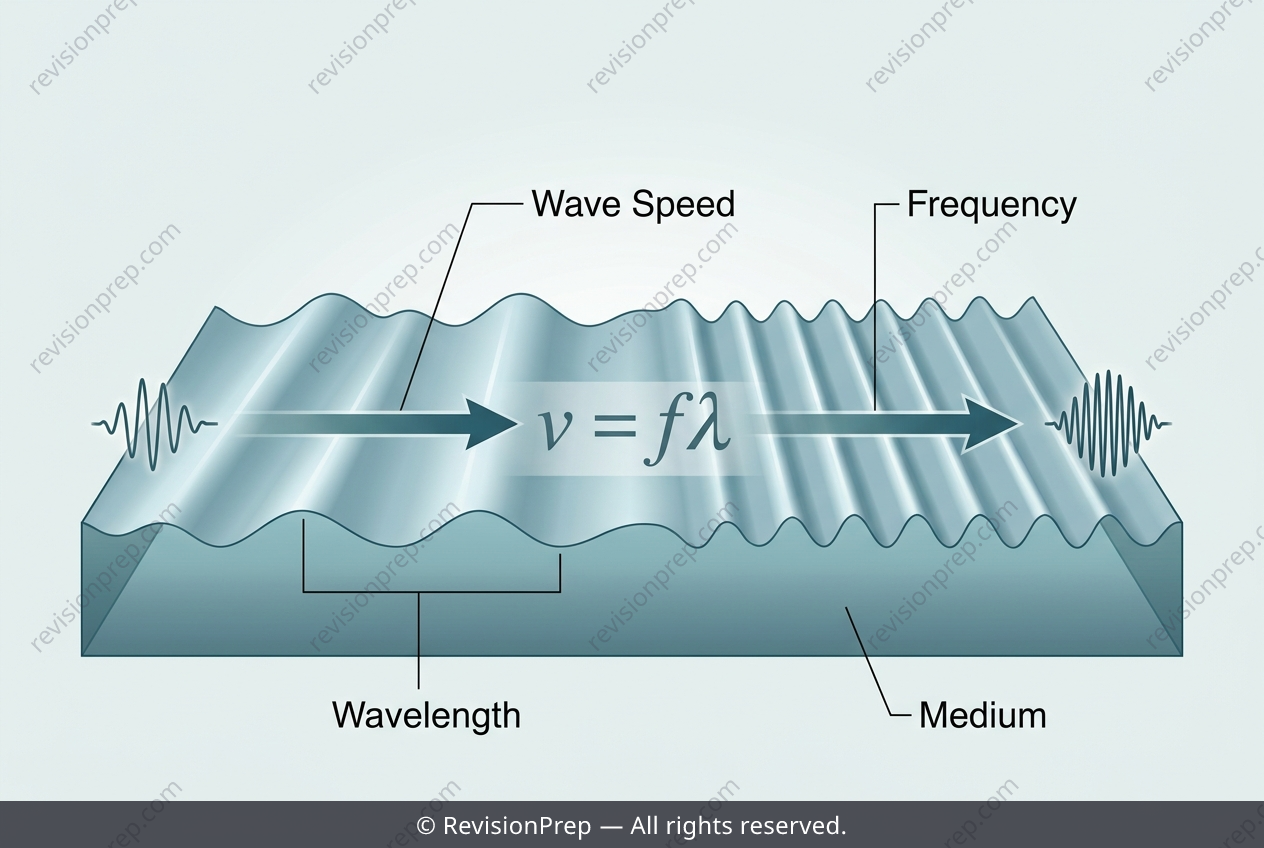
Wave behaviour sits at the heart of understanding how energy moves through a medium without transporting matter itself. In Physics SL, one of the first ideas you meet is that a wave is characterised by its amplitude, frequency, wavelength, and speed — and these are not independent. The wave equation, v = fλ, ties them together: for a given medium, if you change how often the source vibrates (frequency), the distance between successive crests (wavelength) must adjust so that the product stays constant. Why does this matter? Because it reveals a deep principle: wave speed is not set by the source but by the medium itself — its depth, tension, or density. In a ripple tank, water waves travel at a speed fixed by the water’s properties. So when you increase frequency, you are not “pushing” the wave faster; instead, you compress the wavelength proportionally. Amplitude, meanwhile, is a separate measure — the maximum displacement of a particle from its rest position, not the wave’s “height” from crest to trough. Understanding these relationships lets you predict wave behaviour in real contexts, from sound to light to water.
Start practising IB questions today
150,000+ IB-styled questions, criteria-mapped and instantly accessible.