
Economics: J-Curve Effect for IB Economics SL
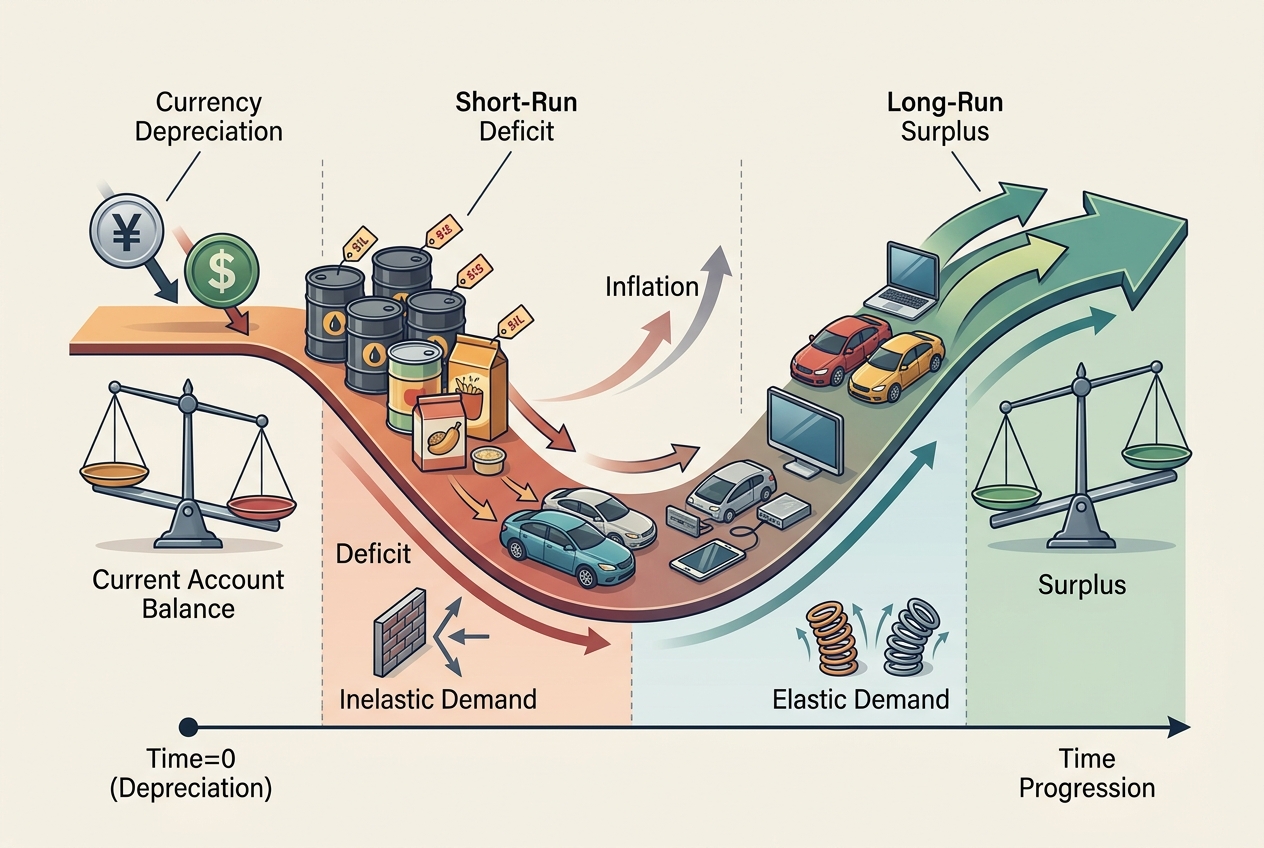
The J-curve effect explains why a currency depreciation often makes a country’s trade balance worse before it gets better. When the yen falls from ¥115 to ¥150 per dollar, Japanese exports become cheaper for foreign buyers, while imports—like energy and food—become more expensive in yen terms. However, in the short run, demand for both is price inelastic: export contracts are already signed, production can’t instantly expand, and essential imports can’t be easily reduced. So the import bill jumps sharply, export revenue rises only modestly, and the current account balance initially deteriorates—the downward dip of the J. Over time, as consumers and firms adjust, elasticities rise. If the Marshall-Lerner condition holds (the sum of export and import price elasticities exceeds 1), the trade balance eventually improves, climbing above its pre-depreciation level. This matters because it shows why policymakers cannot judge a currency’s impact on trade from immediate data alone—the J-curve’s shape links time, price responsiveness, and macroeconomic outcomes like inflation and competitiveness. For Japan, the short-run pain of higher import prices is the price paid for potential long-run export gains.
Start practising IB questions today
150,000+ IB-styled questions, criteria-mapped and instantly accessible.