
Economics: Monetary Policy Trade-Offs in Developing Economies
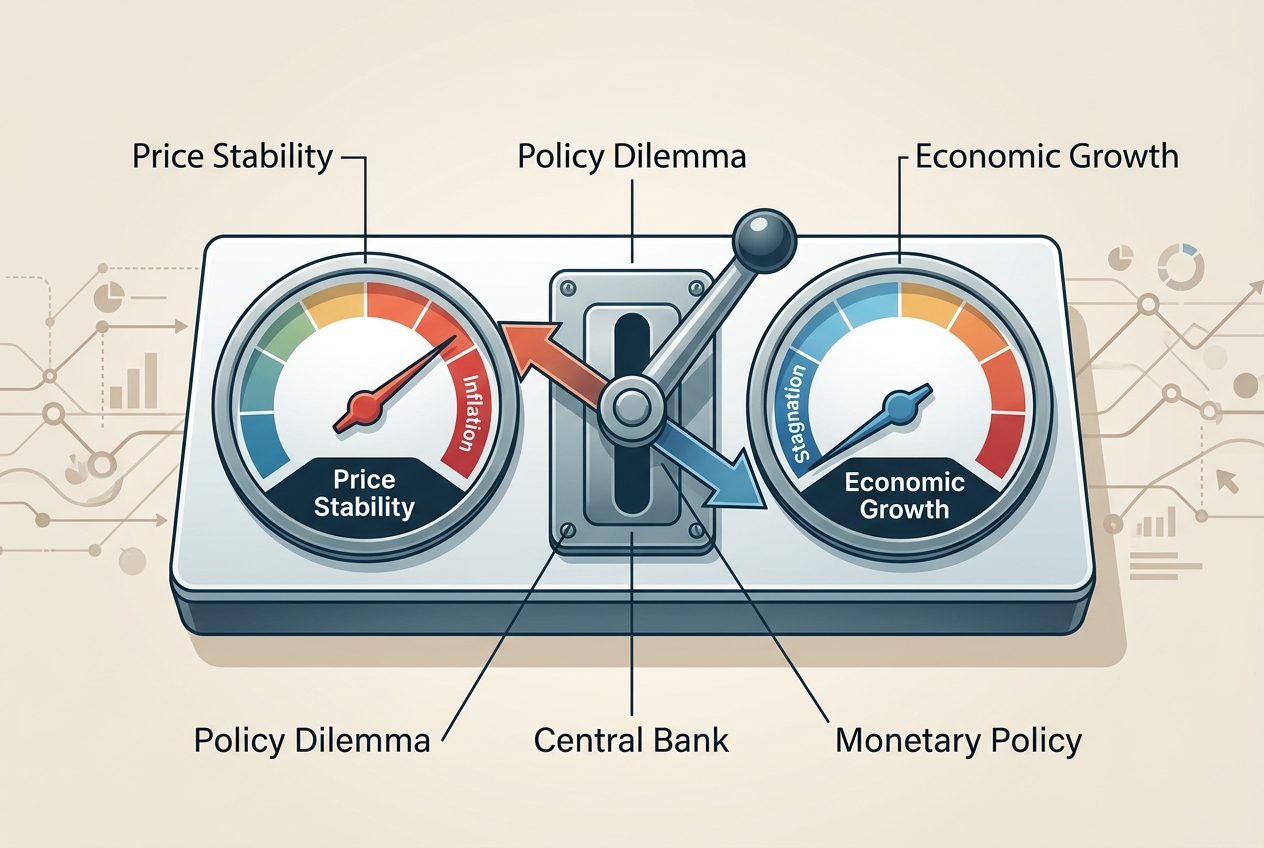
In macroeconomics, a central bank’s dual mandate to maintain price stability while fostering economic growth often creates a fundamental trade-off. When an economy faces both high inflation and output below its full-employment level, any single monetary policy move—whether contractionary or expansionary—improves one objective only at the expense of the other. This tension lies at the heart of monetary policy trade-offs, a core concept in the IB Economics SL syllabus. The conflict arises because the central bank’s primary tool—adjusting interest rates—shifts aggregate demand (AD) along a short-run aggregate supply (SRAS) curve. A contractionary policy (raising rates) reduces inflation by lowering the price level, but it also pushes real GDP further below potential output (Yfe). Conversely, an expansionary policy (cutting rates) boosts growth by raising real GDP toward Yfe, yet it worsens inflation by driving the price level higher. The diagram shows an initial equilibrium where AD₁ intersects SRAS at a point with GDP below Y_fe and prices above target. No single policy can simultaneously move the economy toward both full employment and lower inflation; resolving the dilemma requires prioritising one goal or supplementing monetary policy with supply-side measures that shift the long-run aggregate supply (LRAS) rightward.
Start practising IB questions today
150,000+ IB-styled questions, criteria-mapped and instantly accessible.