
Math Algebraic Simplification with Real-World Cost Modeling
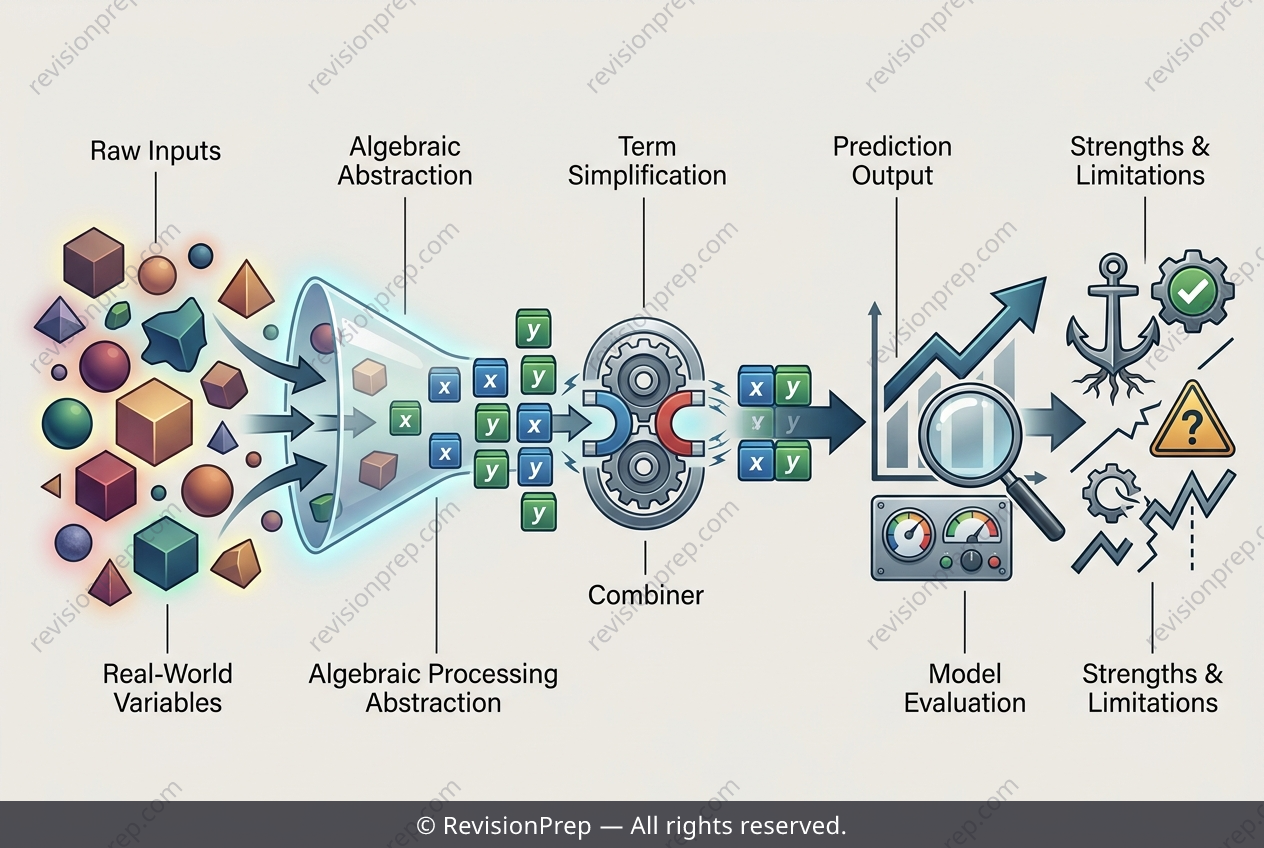
Algebraic simplification and expansion form the backbone of mathematical modeling, turning messy, real-world expressions into clean, workable tools. In this exercise, a construction company’s material cost is captured by the expression 5x + 3y + 2x - y, where x represents the cost per bag of cement and y the cost per box of tiles. The core move here is collecting like terms: 5x and 2x combine into 7x, while 3y and -y collapse into 2y, yielding the simplified form 7x + 2y. This reduction is not just cosmetic—it reveals the underlying structure of the model, showing that total cost scales linearly with the number of bags and boxes. Why does this matter? Because a simplified expression becomes a reusable formula. Once you have 7x + 2y, you can plug in any new unit prices instantly, as the marking scheme highlights—substituting updated values for x and y gives a quick estimate without rebuilding the model. Yet the scheme also pushes you to critically evaluate the model’s limits: it assumes fixed, uniform prices per unit, ignoring bulk discounts on cement or supplier variation in tile costs. Thus, simplification aids speed, but real-world planning demands adjusting for tiered pricing or fluctuating rates—a reminder that every model is a simplification, not a perfect mirror of reality.
Start practising IB questions today
150,000+ IB-styled questions, criteria-mapped and instantly accessible.