
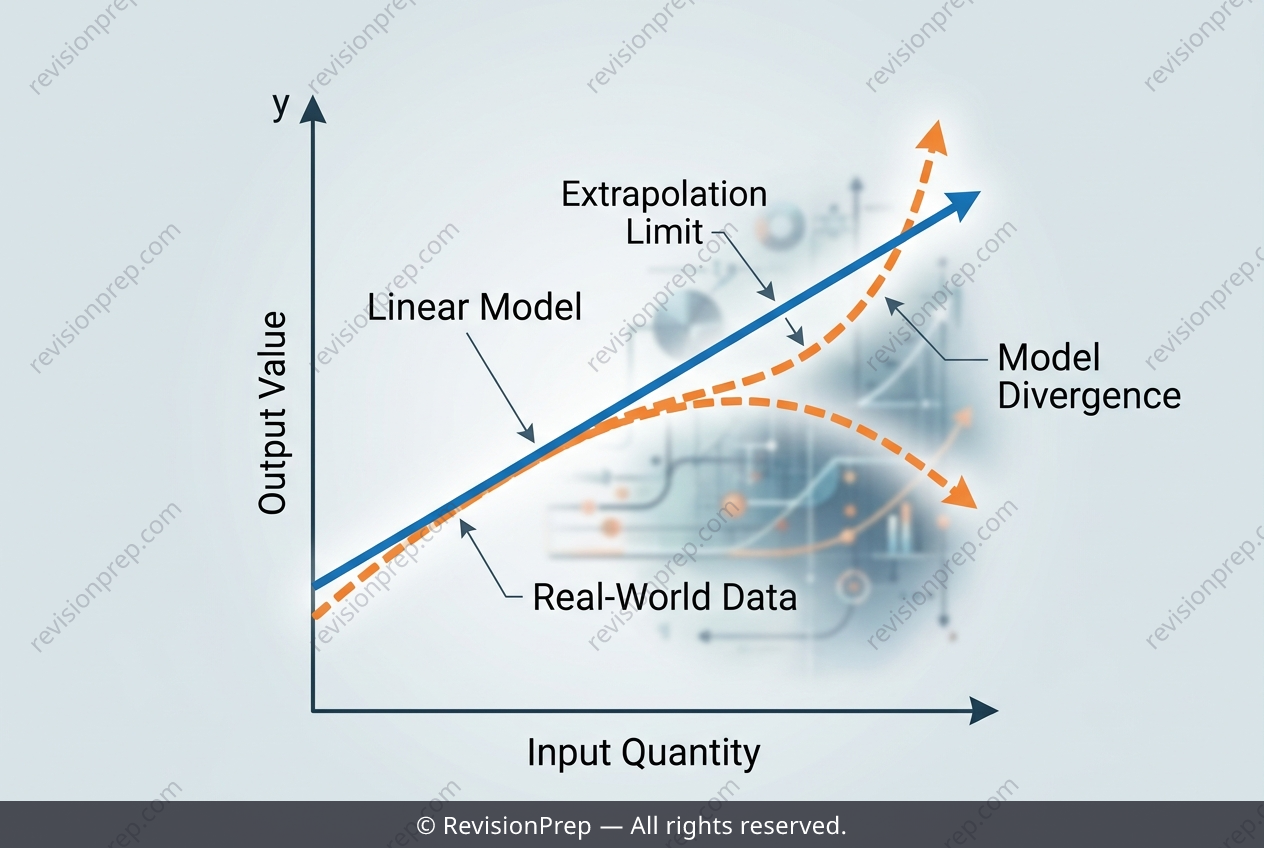
Math Extended: The Limits of Linear Models in Production Costs
Linear models like C(x) = 5x + 20 are powerful because they turn a messy real-world situation into a clean, predictable rule: every extra item adds a constant cost, and there’s a fixed baseline regardless of output. In this case, the coefficient 5 represents the variable cost per item, while the constant 20 stands for fixed costs like rent or insurance. For small production runs, this straight-line relationship works beautifully—plug in any x, and you get a plausible total cost. But the real skill in mathematics is knowing when a model stops being true. The moment you scale production to 1000 items, the assumptions behind that linear equation begin to crack. Bulk purchasing might lower the per-item cost below 5, or the business might need a second warehouse, pushing fixed costs far beyond 20. Either way, the cost curve bends away from a straight line, making the model unreliable. This is the core limitation of mathematical models: they are simplified snapshots, valid only within a certain range. Recognising that boundary—not just calculating with the formula—is what separates a mechanical answer from a meaningful one.
Start practising IB questions today
150,000+ IB-styled questions, criteria-mapped and instantly accessible.