
Maths AI: Area Models with Quadratics: IB Maths AI HL Calculus
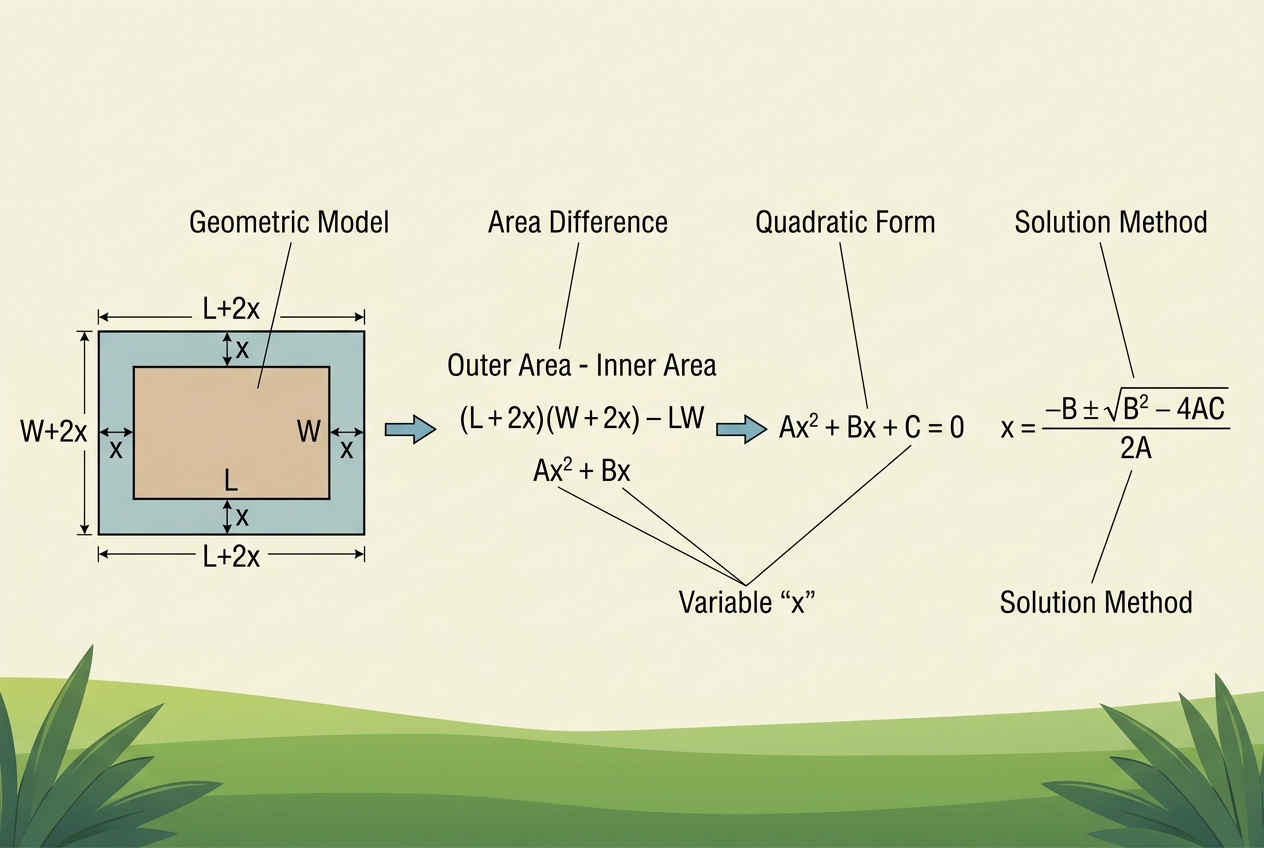
When a fixed shape is extended by a uniform border, the new area is not simply the original area plus a constant—it grows quadratically. This is the heart of algebraic modeling with quadratic equations, a core skill in Maths AI HL Calculus. Here, a rectangular garden of length 12 m and width 8 m is surrounded by a path of width x. The total area becomes (12 + 2x)(8 + 2x), where the 2x accounts for the path added to both opposite sides. The path’s area is found by subtracting the garden’s original area (96 m²) from this expanded product. Expanding (12 + 2x)(8 + 2x) gives 96 + 24x + 16x + 4x², and subtracting 96 leaves 4x² + 40x. This expression reveals the structure: the linear term (40x) comes from the path along the four sides, while the quadratic term (4x²) arises from the four corner squares where the path meets. Setting this equal to a given path area produces a quadratic equation, which factorises into two roots—one positive, one negative. Only the positive root makes physical sense, as a width cannot be negative. This connection between geometry, expansion, and solving quadratics is exactly how real-world “border” problems are modelled and solved.
Start practising IB questions today
150,000+ IB-styled questions, criteria-mapped and instantly accessible.