
Maths: Algebraic Equivalence Through Real-World Discount Models
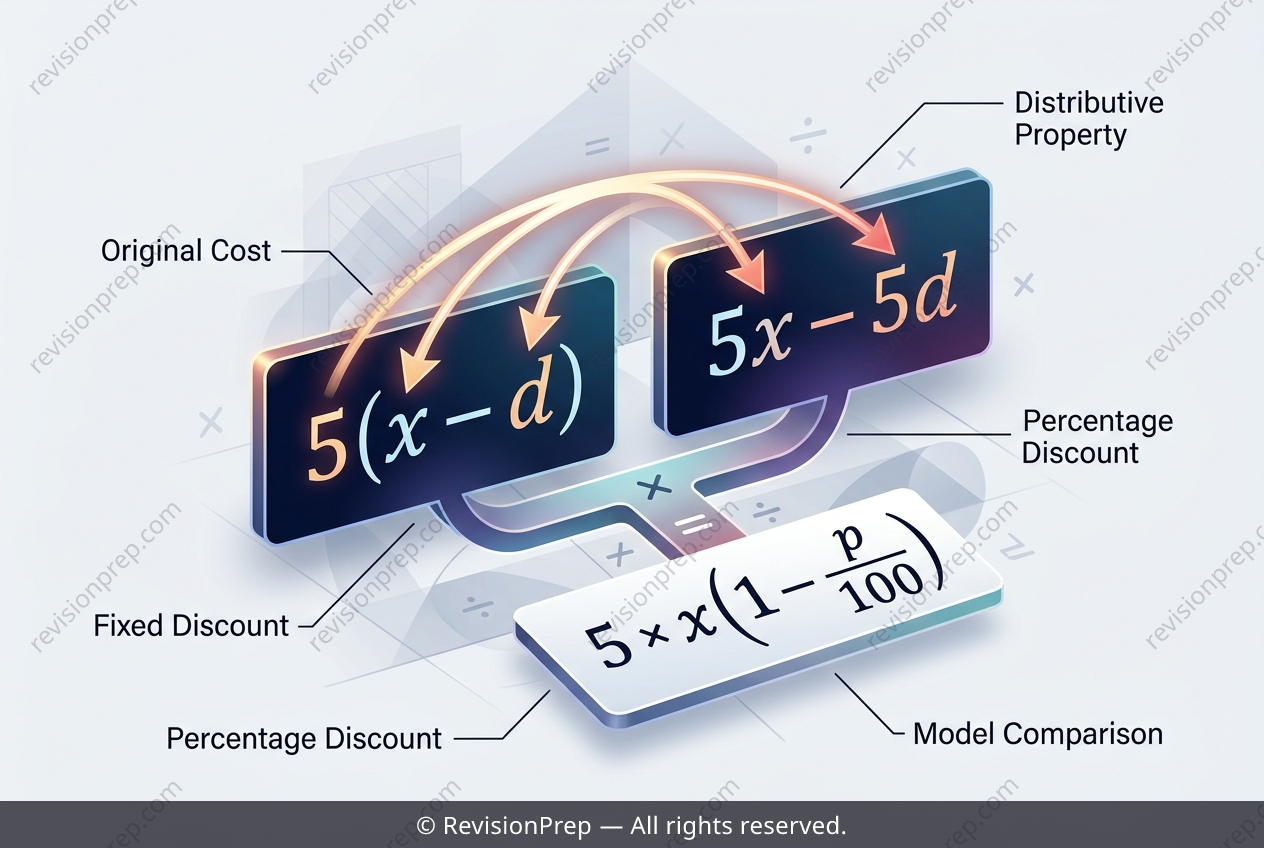
Algebraic equivalence is the quiet engine behind nearly every financial calculation you’ll meet in IB Mathematics — and this question shows exactly why. At its heart, it asks whether two different-looking expressions can represent the same real-world situation, and what happens when they don’t. Here, a fixed discount per item and a percentage discount per item are compared through the lens of expansion and rearrangement. The distributive property turns 5(x − d) into 5x − 5d, where 5x is the full price of five items and 5d is the total saving from a constant reduction applied to each one. That expansion is not just a mechanical step; it reveals how the structure of the expression mirrors the structure of the purchase. The twist comes when the discount is a percentage, p%, rather than a fixed amount. Now each item costs x(1 − p/100), so the total becomes 5x(1 − p/100), which expands to 5x − (5xp)/100. The key relationship is that the two models coincide only when d equals xp/100 — meaning the fixed discount equals the percentage saving at a specific price. This comparison highlights why algebraic equivalence matters: it lets you see when two formulas are truly interchangeable, and when one is merely an approximation that breaks down as variables change.
Start practising IB questions today
150,000+ IB-styled questions, criteria-mapped and instantly accessible.