
Maths: Algebraic Expressions and Measurement Error in Garden Perimeter Problems
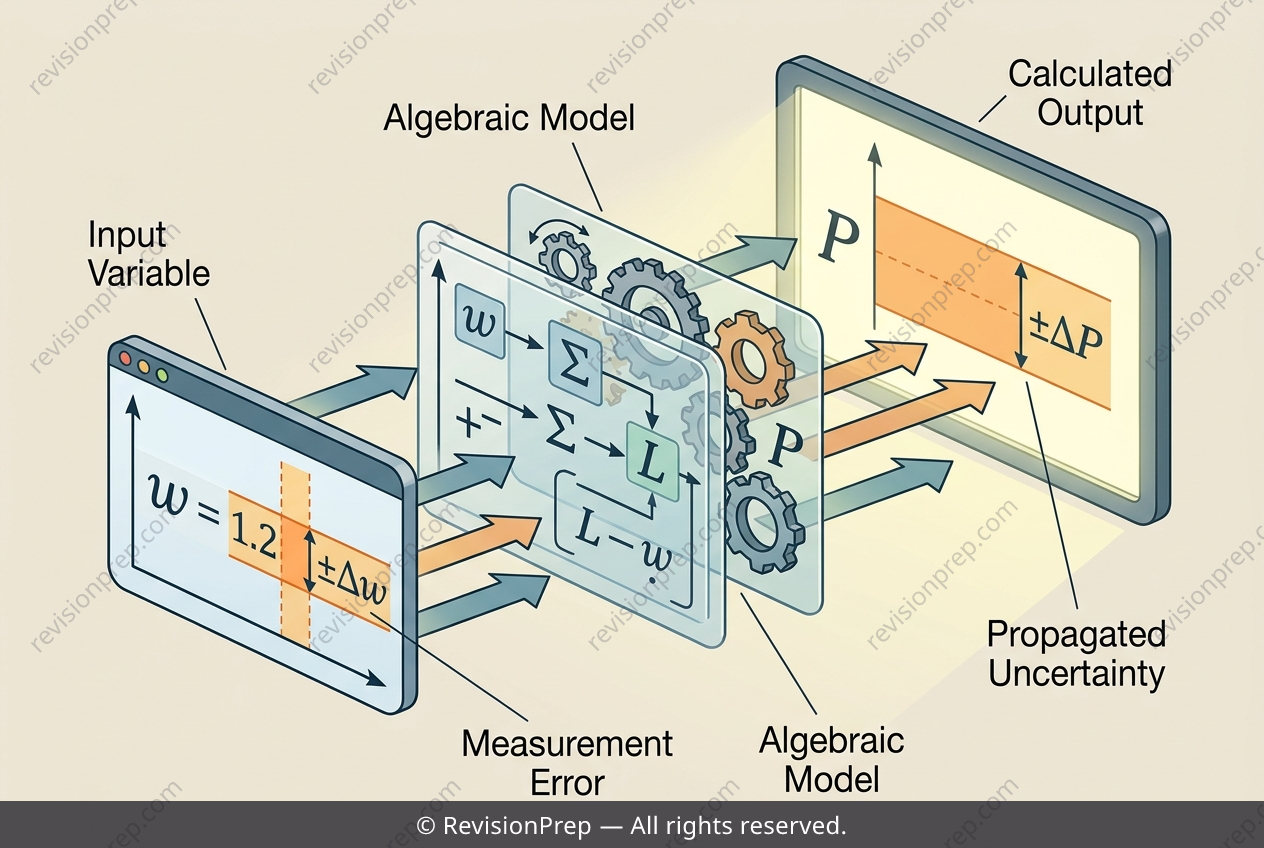
Algebraic expressions are the language we use to turn real-world situations into mathematical relationships. In this case, a simple garden design gives us a perfect window into how a phrase like “the length is 3 metres more than twice the width” becomes the expression 2w + 3. From there, we can build the perimeter formula, which combines length and width into a single, simplified expression: 6w + 6. This process—translating words into symbols, then simplifying—is the backbone of all algebra. But the real power of this expression shows up when we introduce uncertainty. Measurements are never perfect, and a stated width of 5 m with an error of ±0.5 m means the actual width could be anywhere from 4.5 to 5.5 m. Because the perimeter formula multiplies the width by 6, that small error in width gets amplified sixfold in the perimeter. This connection between the coefficient in your expression and the propagation of error is crucial: it tells you how sensitive your final answer is to input mistakes. Understanding this relationship helps you predict how much confidence you can place in your calculations—and why precise measurement matters in every applied maths problem.
Start practising IB questions today
150,000+ IB-styled questions, criteria-mapped and instantly accessible.