
Maths: Algebraic Expressions: Modeling Real-World Scenarios with Brackets
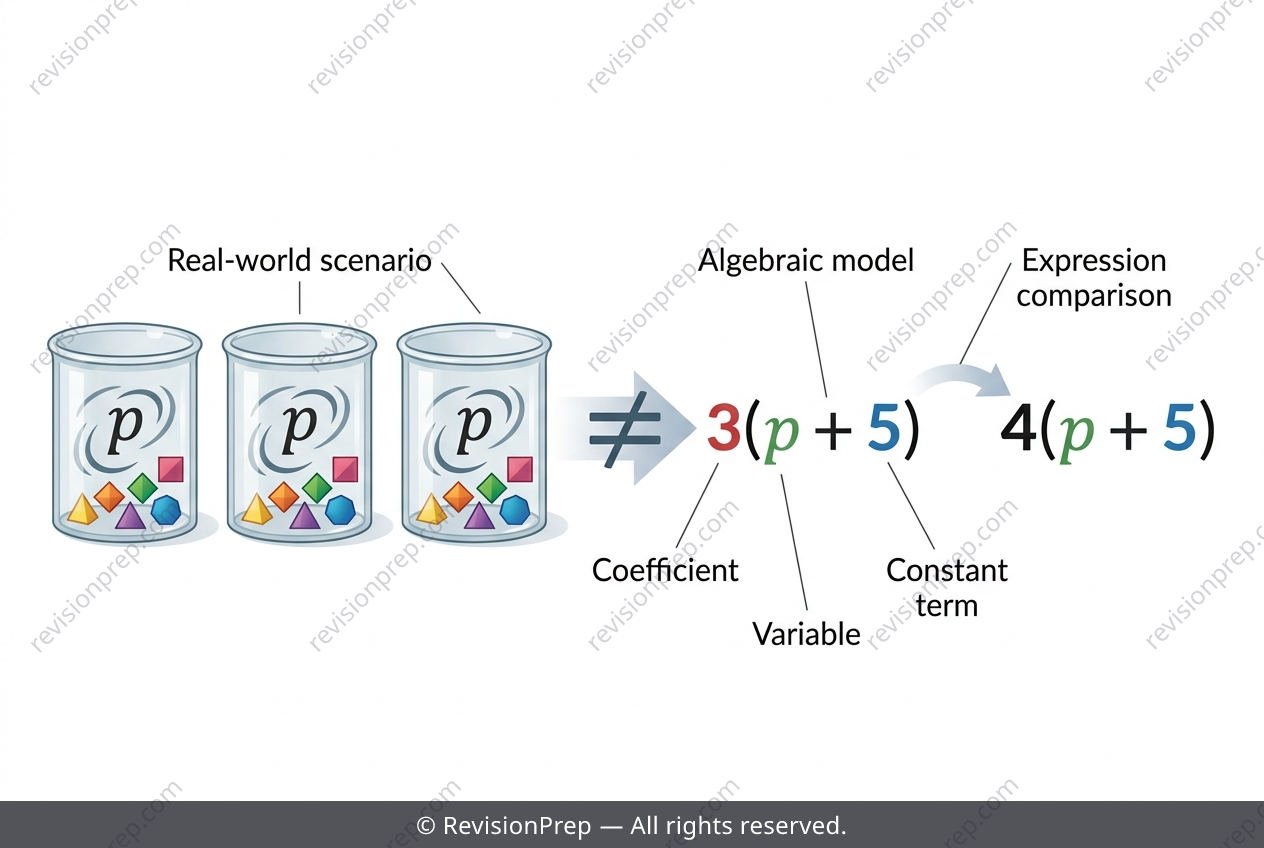
Algebraic expressions are the language we use to translate real-world situations into mathematics. At their heart, they let us describe quantities that change or are unknown, using letters like p to stand in for values we don’t yet know. In this case, a bag holding (p + 5) apples isn’t just a sum—it’s a compact story: a starting, unknown amount p, plus five more apples added on top. When you have three identical bags, the expression 3(p + 5) captures both the repetition (three groups) and the structure inside each group. Why does this matter? Because the way you write an expression changes what it means. The brackets in 3(p + 5) signal that the entire contents of one bag—the unknown p and the fixed 5—are multiplied by 3, not just the p. Compare that to 4(p + 2): here, the number of groups shifts from 3 to 4, and the extra per group drops from 5 to 2. These two differences—how many groups and how much extra each group holds—are the core relationships that turn a word problem into a precise, reusable mathematical model. Understanding these parts is the first step toward solving and interpreting any real-world scenario algebraically.
Start practising IB questions today
150,000+ IB-styled questions, criteria-mapped and instantly accessible.