
Maths: Algebraic Expressions Through Real-World Cost Modeling
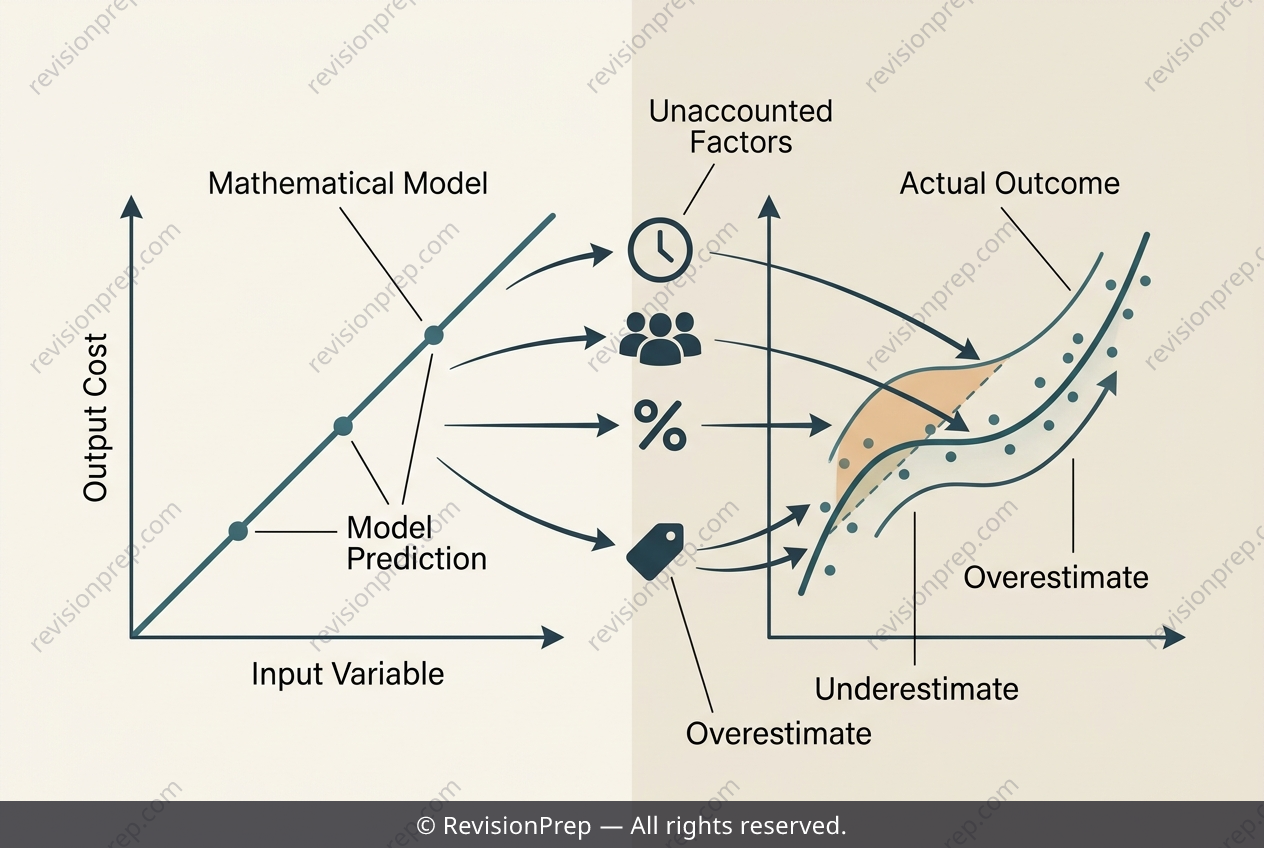
Algebraic expressions are the language we use to translate real-world situations into mathematics. In this case, the simple expression 5 + 2n captures the total cost of a school fair visit, where 5 represents a fixed entry fee and 2n represents the variable cost of ride tickets. This single formula is a powerful tool: it lets us calculate any person’s cost instantly, just by substituting a value for n. But the real insight lies in understanding that this expression is a model—a simplified version of reality. It assumes every ticket costs the same, every person pays the same entry fee, and there are no discounts or hidden charges. When we use the model to find the cost for one person, then multiply by four for a family, we are applying the expression in a linear, additive way. However, the marking scheme highlights that real-world factors—like a family discount—are omitted. Ignoring such a factor doesn’t just make the model less accurate; it systematically skews the estimate, often causing an overestimate. Recognizing what a model includes, what it leaves out, and how that omission shifts the result is the essence of mathematical modeling—and the key to interpreting any formula critically.
Start practising IB questions today
150,000+ IB-styled questions, criteria-mapped and instantly accessible.