
Maths: Algebraic Expressions: Variables, Coefficients & Constants in Real-World Costs
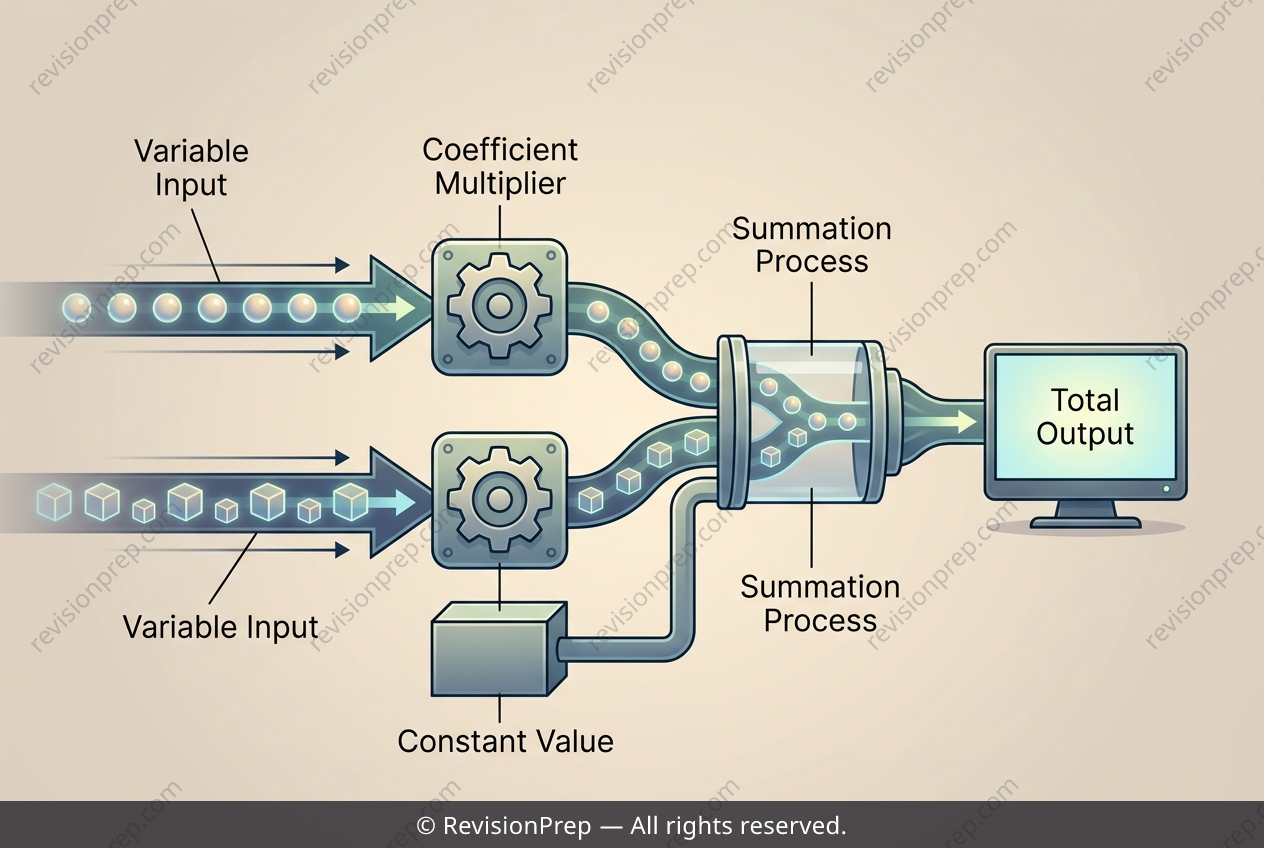
Algebraic expressions are the language we use to turn real-world situations into compact, solvable mathematical statements. At their heart sit two kinds of building blocks: variables, which stand for quantities that can change, and constants, which hold fixed values. When you combine them with operations like addition and multiplication, you create a formula that can model anything from a café order to a physics equation. In this context, the total cost of a purchase is built by multiplying each variable (number of burgers, number of drinks) by its own coefficient—the price per unit—and then adding a constant that represents a fee independent of quantity. The coefficient tells you how much the total changes for each additional item, while the constant remains untouched, anchoring the expression. Understanding this structure lets you not only write the expression but also interpret what each number means in the original scenario. Once you see how variables, coefficients, and constants connect, you can translate almost any word problem into a clean algebraic form—and read the story back from the math.
Start practising IB questions today
150,000+ IB-styled questions, criteria-mapped and instantly accessible.