
Maths: Algebraic Expressions with Real-World Combo Meal Problems
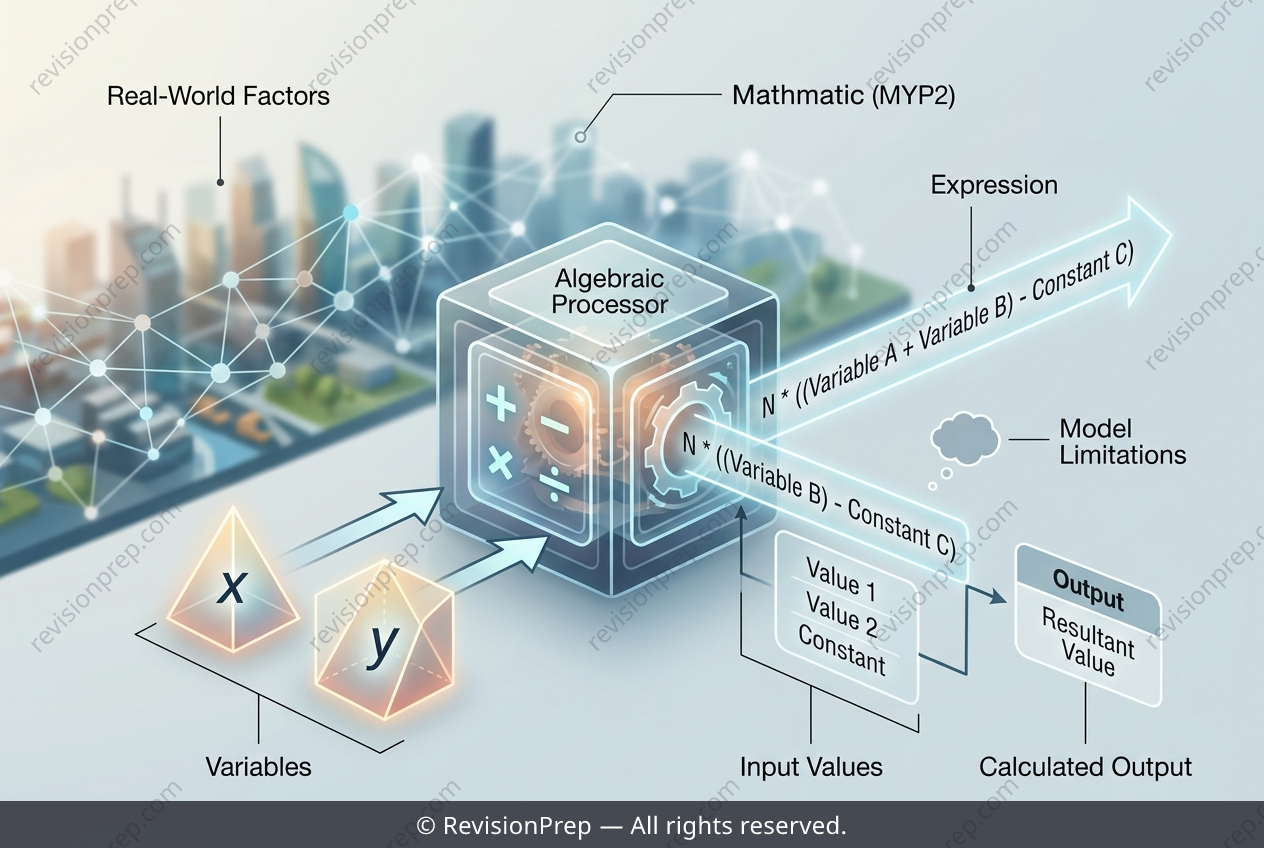
Algebraic expressions are the language of generalisation in mathematics—they let us describe a pattern or a real-world situation with symbols instead of fixed numbers. In this case, a tuckshop combo meal is modelled as (x + y) − 0.50, where x is the cost of a sandwich, y is the cost of a drink, and the 0.50 represents a discount applied to the combined price. This single expression captures three operations at once: addition (combining item costs), subtraction (applying the discount), and, when you need five meals, multiplication by 5. What makes this concept powerful is how the parts connect. The expression 5[(x + y) − 0.50] shows that the discount is applied per meal before the total is scaled—so the structure matters, not just the arithmetic. It also reveals a key assumption: x and y are treated as constants, meaning every sandwich and every drink costs the same. In reality, a tuckshop might sell different types of sandwiches at different prices, so a single x cannot capture that variation. Understanding how to build, evaluate, and critique such expressions is essential for translating everyday scenarios into mathematics—and for spotting when a model oversimplifies the truth.
Start practising IB questions today
150,000+ IB-styled questions, criteria-mapped and instantly accessible.