
Maths: Algebraic Modeling: From Word Problems to Expressions
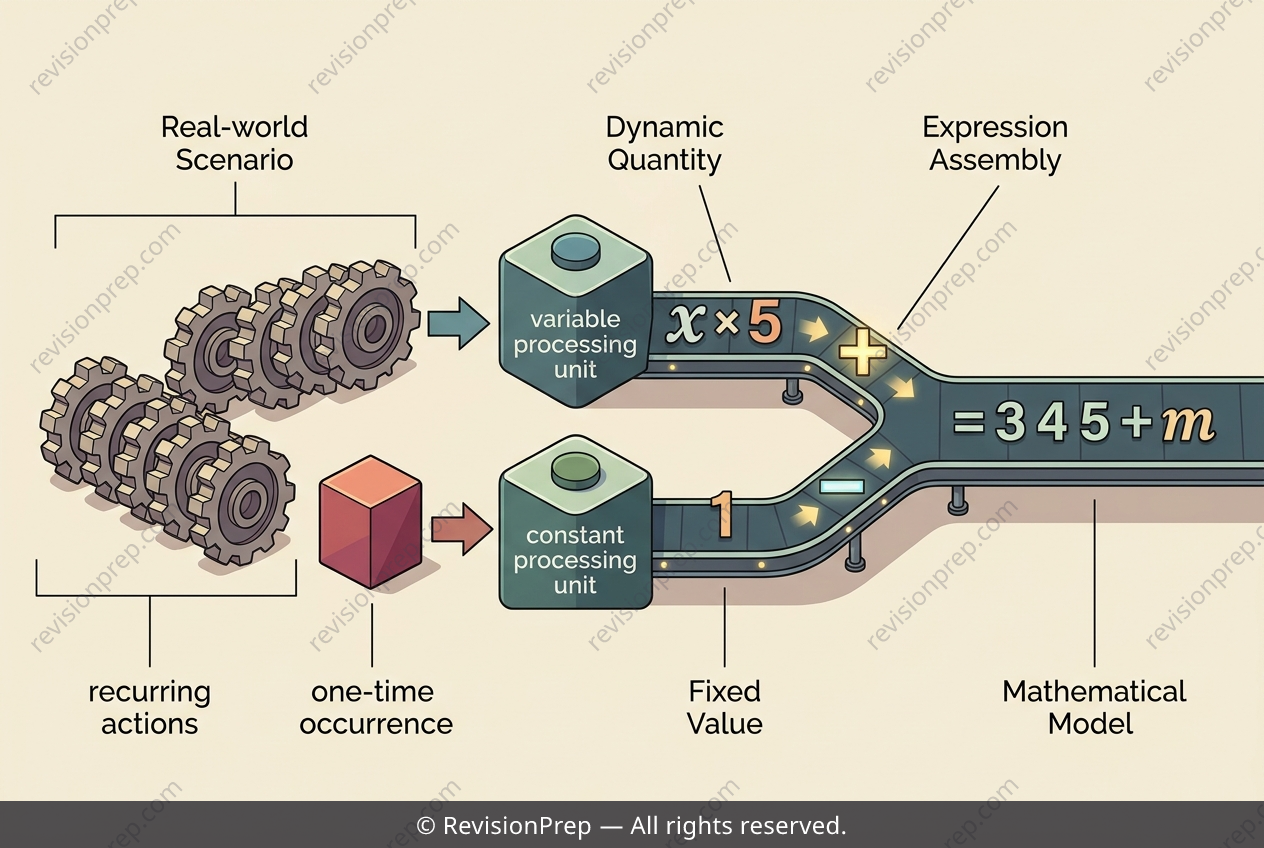
Algebraic modeling is the art of translating a real-world situation into a mathematical expression—turning words like “a student saves £m each week” into a compact, manipulable form. In this case, the core idea is that a variable (m) represents an unknown weekly amount, while a constant (4) represents a fixed, one-time gift. The expression 3m + 4 captures two distinct parts: a variable term that scales with time (3 weeks × m) and a constant term that does not change regardless of how many weeks pass. Why does this matter? Because nearly every IB Mathematics problem—from finance to physics—relies on separating what varies from what stays fixed. Here, the relationship is additive: total savings = (weekly saving × number of weeks) + gift. If the saving period changes from 3 to 5 weeks, only the variable part updates (3m becomes 5m), while the constant 4 remains untouched. This distinction between coefficient (the number of weeks) and constant (the gift) is the backbone of expression formation. Mastering this lets you model any scenario where a rate multiplies a quantity, plus a one-off adjustment—a skill you’ll reuse across algebra, sequences, and even calculus.
Start practising IB questions today
150,000+ IB-styled questions, criteria-mapped and instantly accessible.