
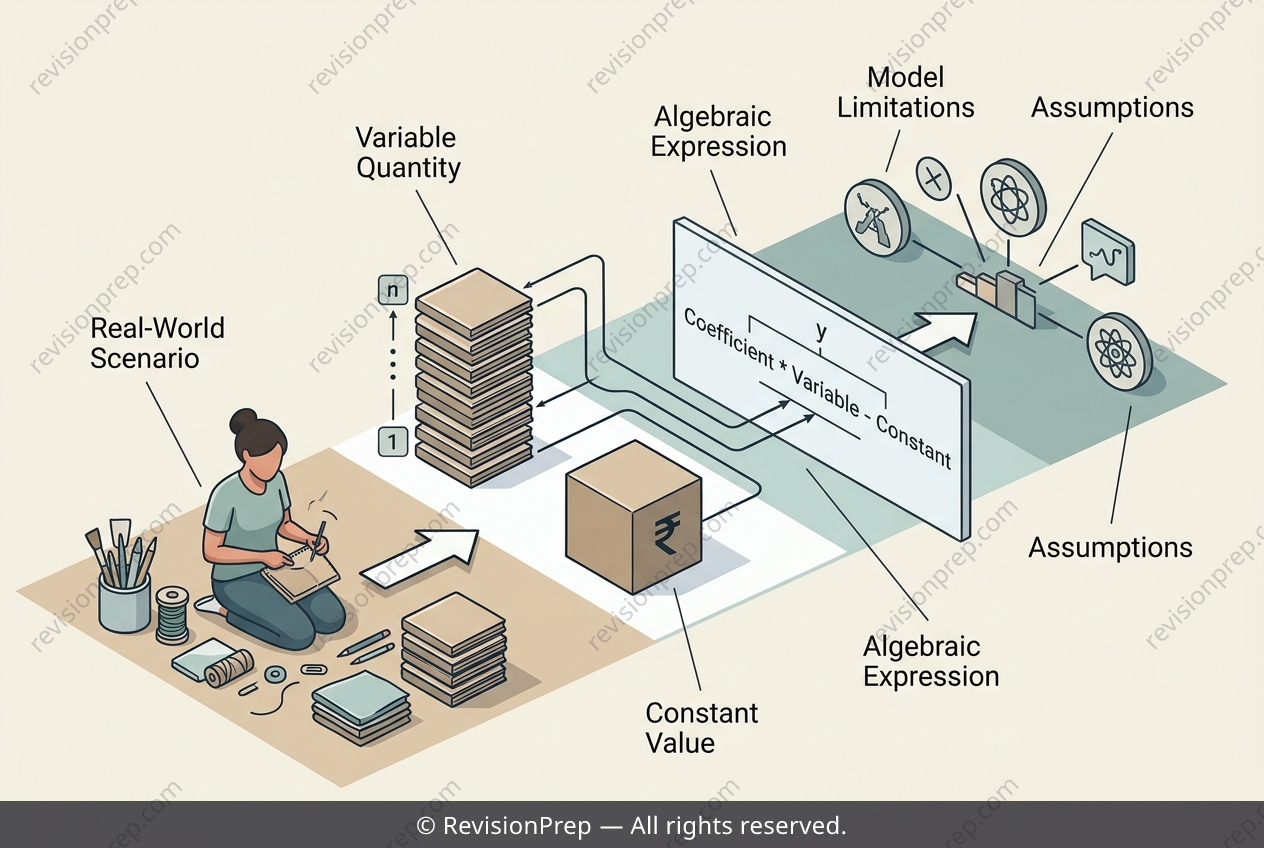
Maths: Algebraic Modeling: Variables, Constants, and Profit Limitations
Algebraic modeling is the art of translating a real-world situation into mathematical language, and at its heart lie two fundamental building blocks: variables and constants. In the bracelet-selling scenario, the expression 3b - 6 captures a small business in a single line: the constant 6 represents the fixed cost of supplies, while the coefficient 3 is the constant price per bracelet. The variable b, however, is the dynamic piece—it stands for the number of bracelets sold, the one quantity that can change and drive the profit up or down. Understanding how these parts connect is crucial, but so is recognizing their limits. The model treats supply costs as a rigid 6 dollars, yet in reality, buying more materials for extra bracelets would raise that cost, meaning the expression could overestimate true profit. Likewise, it assumes every bracelet sells at exactly 3 dollars and that b can be any number—even a fraction or a negative, which makes no sense for physical items. This tension between the clean logic of algebra and the messiness of real life is precisely why modeling matters: it gives you a powerful tool, but only if you know where its edges fray.
Start practising IB questions today
150,000+ IB-styled questions, criteria-mapped and instantly accessible.