
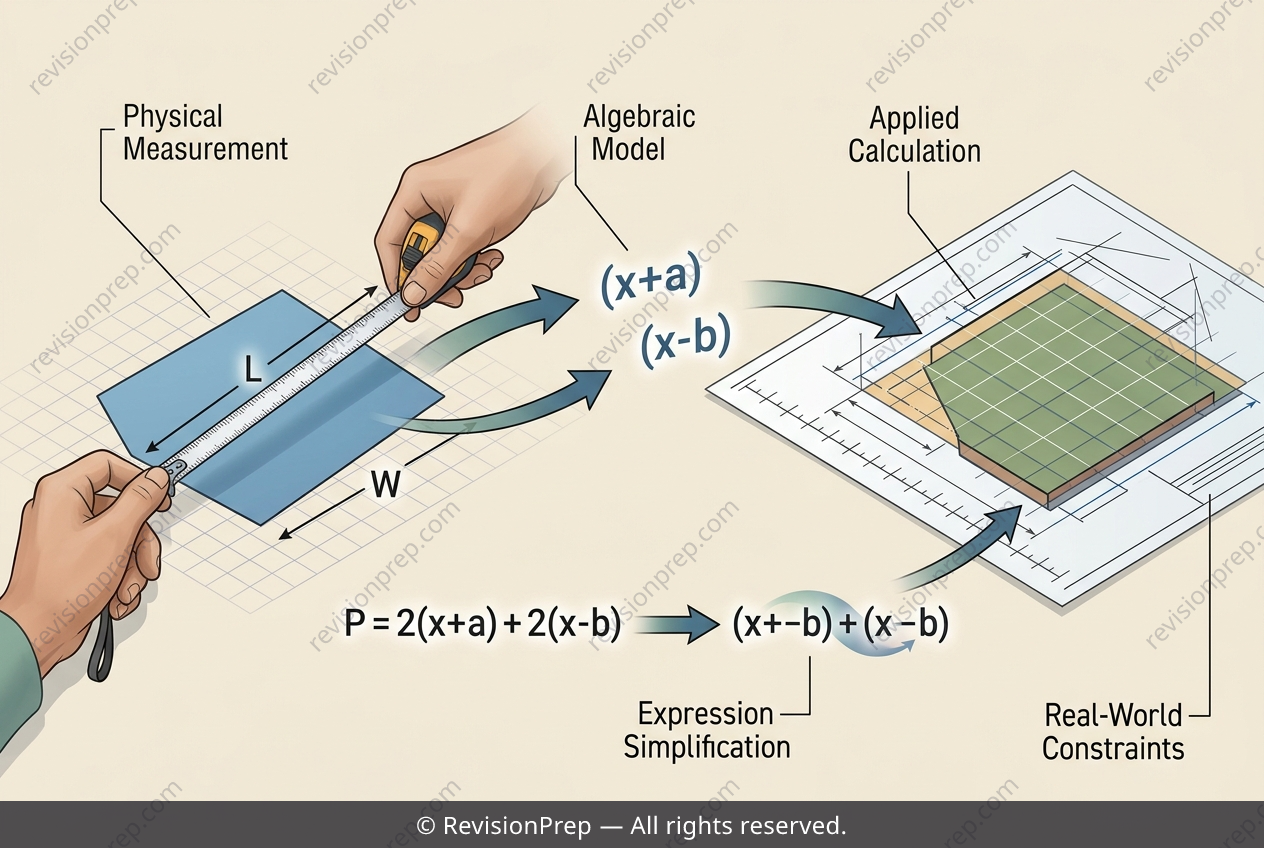
Maths: Algebraic Modeling with Rectangular Garden Fencing Problems
Algebraic modeling is the art of translating a real-world situation into mathematical language—and in this case, that language is built from variables, operations, and brackets. When you write an expression for the perimeter of a rectangular garden with length (x + 5) and width (x − 2), you are not just manipulating symbols; you are capturing a physical relationship. The perimeter formula, P = 2(length + width), becomes a compact tool that lets you see how the total fencing depends on the unknown value of x. What makes this concept powerful is how its parts connect. The brackets first force you to add the two side expressions before doubling, preserving the structure of the rectangle. Then, simplifying by collecting like terms—turning (x + 5) + (x − 2) into (2x + 3)—reveals the underlying linear relationship. Finally, the interpretation step reminds you that a model is a simplification: it assumes a perfect, unbroken rectangle, but real gardens have gates, uneven ground, or other features that can shift the actual requirement. Understanding this chain—from setup, to simplification, to interpretation—is the essence of algebraic thinking.
Start practising IB questions today
150,000+ IB-styled questions, criteria-mapped and instantly accessible.