
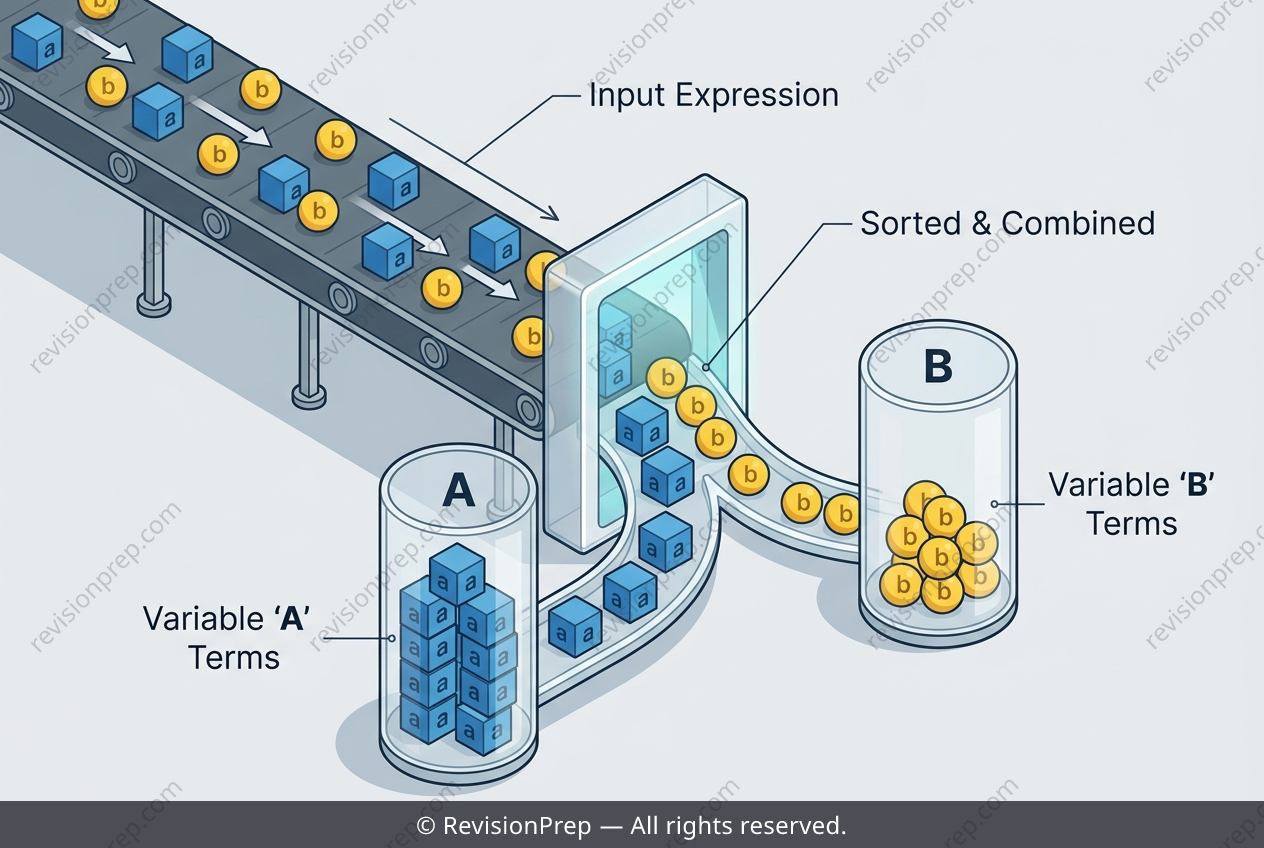
Maths: Algebraic Simplification: Combining Like Terms in Real-World Problems
Algebraic simplification is the art of tidying up mathematical expressions so they are easier to read, compare, and evaluate. At its heart lies the rule that you can only combine “like terms”—terms that share the exact same variable (or variables) raised to the same power. In the expression 3a + 2b + 5a, the terms 3a and 5a are like terms because both represent multiples of the same unknown quantity, a. They combine to give 8a. The term 2b, however, is different: it involves b, not a, so it must remain separate, giving the simplified form 8a + 2b. Why does this matter? Because variables stand for real-world quantities. Here, a is the price per apple and b is the price per banana—two distinct items that may cost different amounts. Adding 3a and 2b would be like adding the cost of three apples to the cost of two bananas as if they were the same fruit; it mixes units that have no common measure. This distinction is not just a classroom rule—it has practical consequences. If you incorrectly combine unlike terms, your final expression will misrepresent the true total cost, leading to overestimates or underestimates when you substitute actual prices. Mastering like terms ensures your algebra mirrors reality, not just the page.
Start practising IB questions today
150,000+ IB-styled questions, criteria-mapped and instantly accessible.