
Maths: Angle Rules: Parallel Lines and Transversals Explained
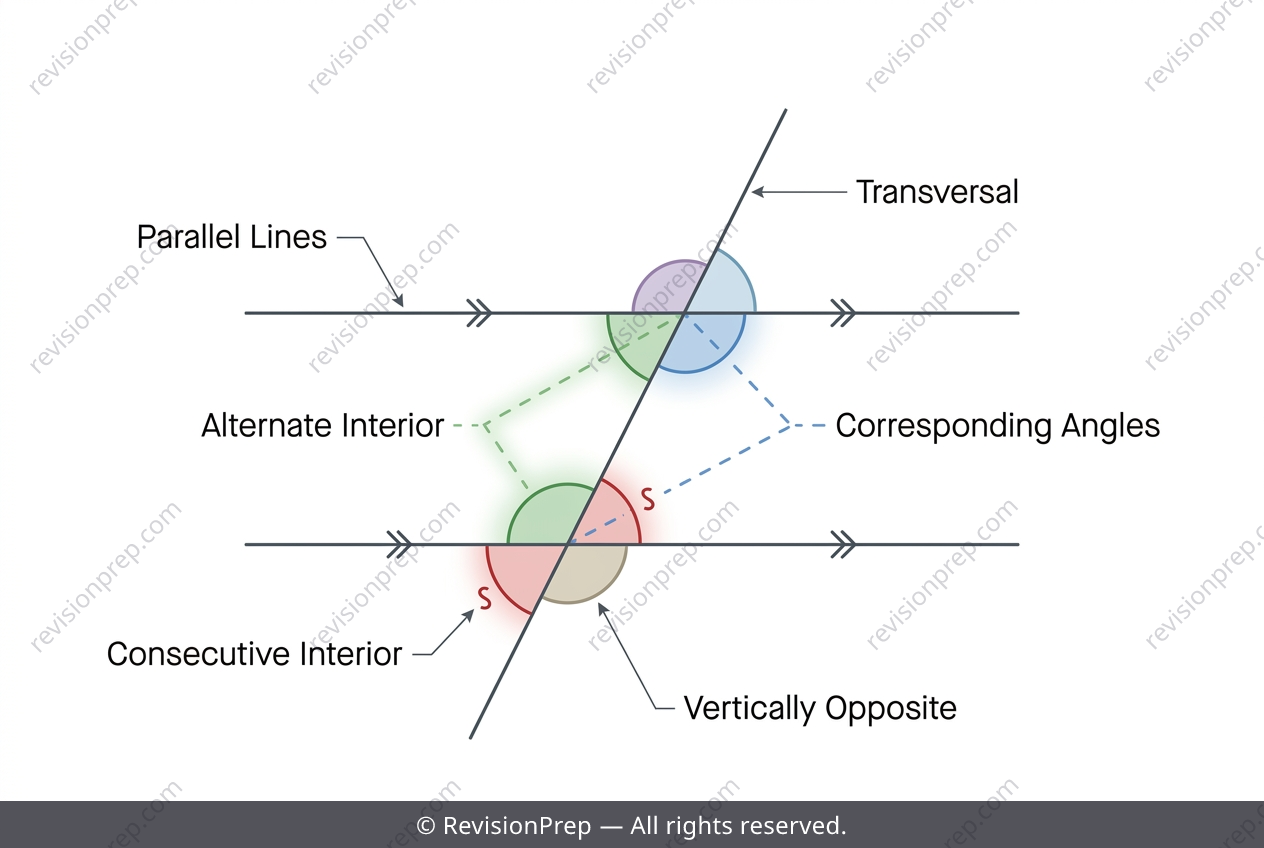
Parallel lines and a transversal form one of the most elegant relationships in geometry: when a single straight line cuts across two parallel lines, it creates angles that are locked in predictable pairs. At the heart of this topic is the transversal—the line that crosses both parallels—and the special angles it produces, such as alternate interior angles. These are the angles that sit between the two parallel lines, on opposite sides of the transversal, and their defining property is equality: if the lines are truly parallel, alternate interior angles are always the same size. This idea is more than a rule to memorise; it is a proof mechanism. Once you identify a pair of alternate interior angles, you can immediately state their measure without measuring, because the parallelism guarantees the relationship. The position matters—one angle must be between the tracks (or lines), the other on the opposite side of the crossing line—and both conditions must hold. Understanding this connection between position and equality lets you solve for unknown angles, verify parallelism, and build logical chains in geometric proofs. It is the bridge between a diagram’s visual layout and the algebraic certainty of angle values.
Start practising IB questions today
150,000+ IB-styled questions, criteria-mapped and instantly accessible.