
Maths: Bearings: Applying Angle Properties to Real-World Navigation
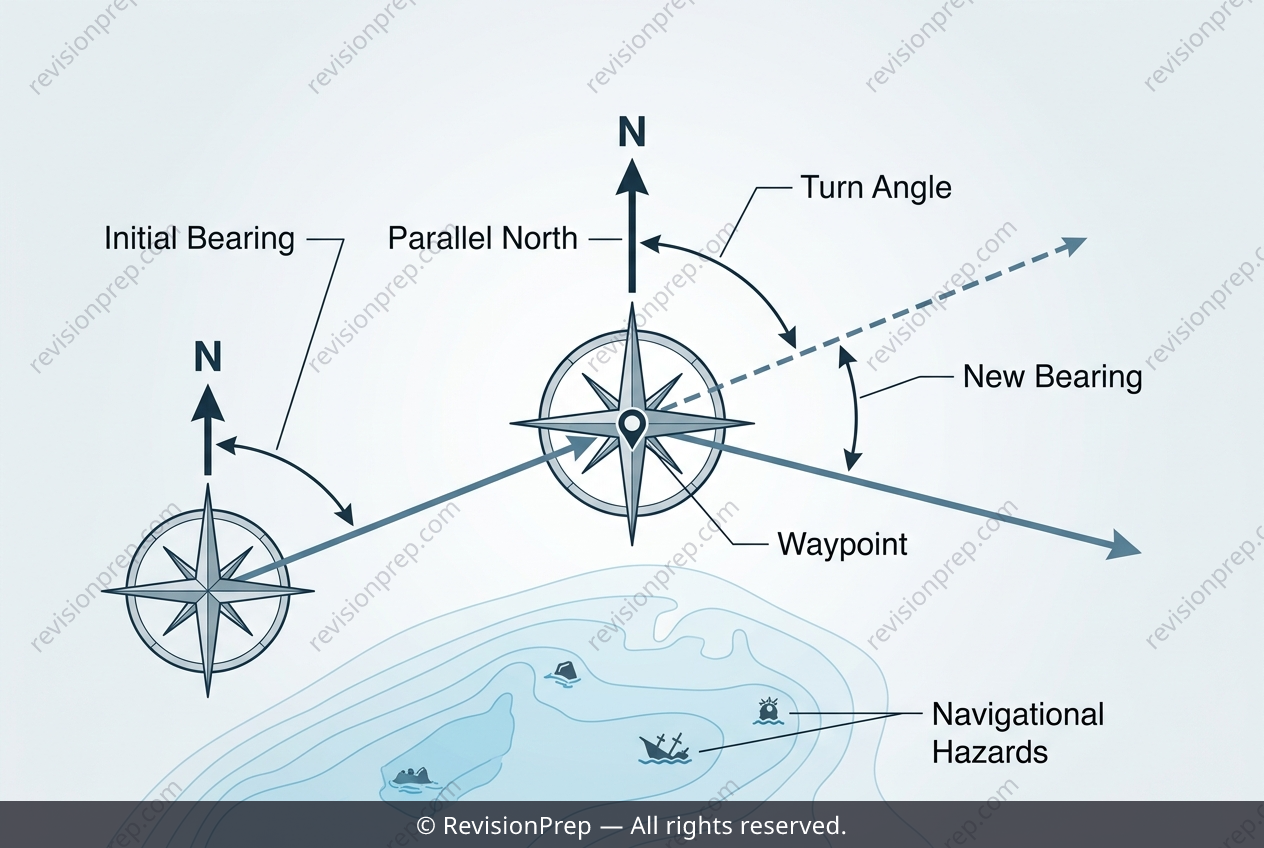
Navigating the open ocean is, at its heart, a problem of applied geometry. Every plotted course relies on the precise relationship between lines and the angles they create, transforming abstract mathematical principles into the practical skill of wayfinding. In this exercise, we explore how a ship’s journey between two points, defined by bearings measured clockwise from north, reveals a core geometric concept: the angle formed when a vessel changes direction. The difference between two bearings—here, 030° and 150°—directly yields the size of the turn, a value that falls neatly into the category of an obtuse angle, since it lies between 90° and 180°. Yet the power of this calculation extends far beyond identifying a shape. The turn angle quantifies the sharpness of the course correction, but it is only one piece of a larger navigational puzzle. While subtracting the initial bearing from the final bearing (150° − 30°) gives the precise measure of the change in direction, this number alone cannot guarantee a safe route. The angle tells you how sharply to turn, but not how far to travel on each leg—distance remains a separate, critical variable. Furthermore, real-world forces like ocean currents can silently push a vessel off its plotted line, meaning the actual path deviates from the geometric ideal. Thus, the simple act of calculating an angle connects directly to the complex, dynamic reality of maritime navigation, where theory meets the unpredictable sea.
Start practising IB questions today
150,000+ IB-styled questions, criteria-mapped and instantly accessible.