
Maths: Budget Word Problems: Equations, Inequalities & Whole Numbers
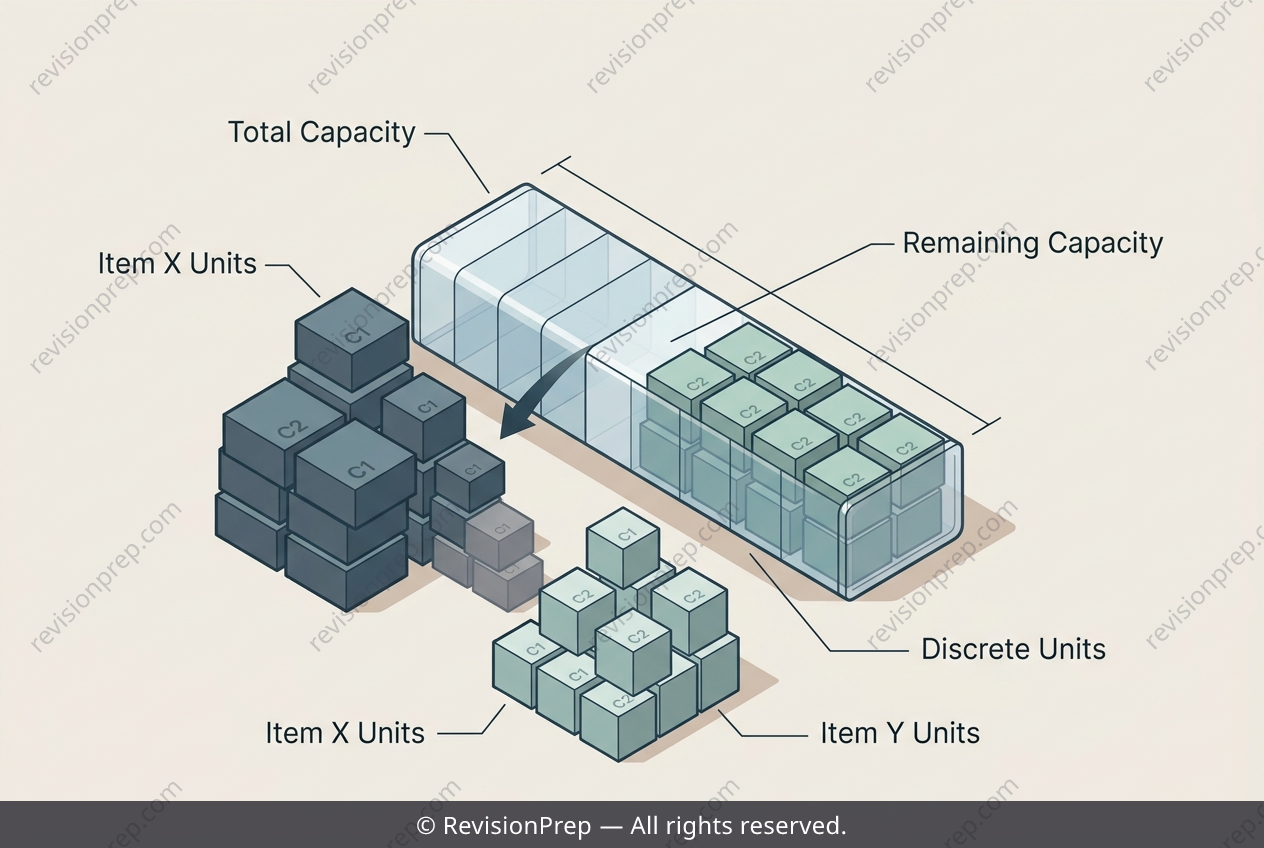
Word problems often feel like a test of reading comprehension, but at their core they are about translation: turning a real-world situation into a precise mathematical statement. In this case, the situation is a classic resource allocation problem—a fixed budget of 50 dollars split between two items with different prices. The key move is to define variables for the unknown quantities (n for notebooks, p for pens) and then express the total cost as an equation: 3n + 1.5p = 50. This single equation captures the constraint that every dollar must be accounted for, and it becomes the foundation for all further reasoning. What makes this problem richer is the hidden layer of discreteness. Algebra gives you a smooth, continuous answer—here, a fractional value for n—but the real world does not allow you to buy a third of a notebook. This forces you to interpret the mathematical result through the lens of the context: you must round down to the nearest whole number, because the variable n represents a countable object. The equation itself is necessary, but not sufficient; the final step is always checking that your solution makes sense in the original scenario. This blend of symbolic manipulation and contextual judgment is what separates a purely mechanical answer from a truly modelled one.
Start practising IB questions today
150,000+ IB-styled questions, criteria-mapped and instantly accessible.