
Maths: Circle Properties: Precision with a Compass
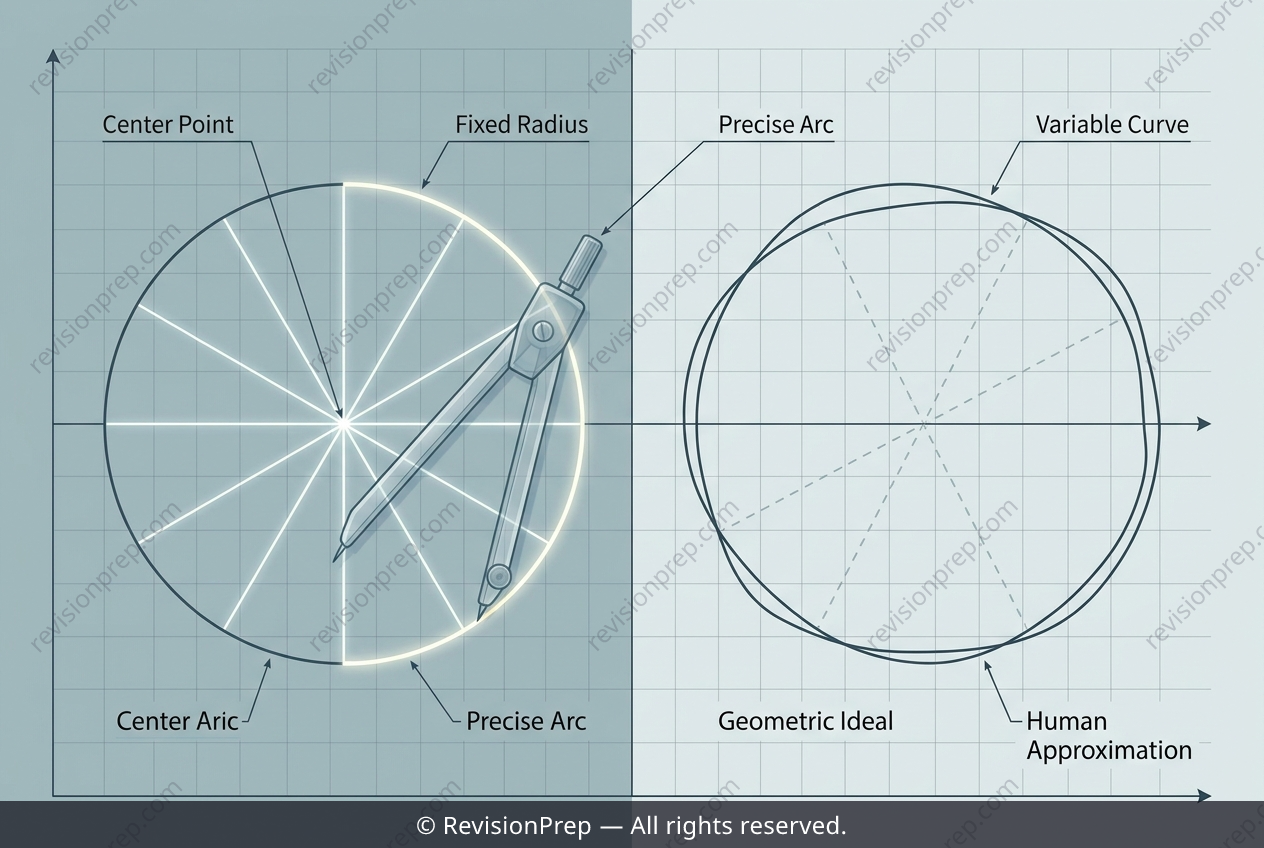
A circle is far more than a simple shape—it is a precise mathematical locus, defined as the set of all points at a fixed distance (the radius) from a single central point. When you use a compass, you are physically enacting this definition: the needle point anchors the centre, while the pencil tip traces every point equidistant from it. This tool transforms an abstract geometric condition into a visible, measurable curve. The compass’s two contact points—the stationary needle and the moving pencil—are not just mechanical parts; they embody the two core elements of circle geometry: a fixed centre and a constant radius. For the circle to be perfect, the needle must remain immovable, acting as the origin, while the pencil arm rotates smoothly in one continuous sweep, maintaining that fixed distance throughout. This is why a compass-drawn circle is smooth and even, whereas a freehand attempt wobbles—because the radius subtly changes with every hand tremor. Understanding this mechanism connects the tool’s operation directly to the definition of a circle, reinforcing why geometric precision is not about artistic skill, but about upholding a mathematical invariant.
Start practising IB questions today
150,000+ IB-styled questions, criteria-mapped and instantly accessible.