
Maths: Combined Transformations and Matrices
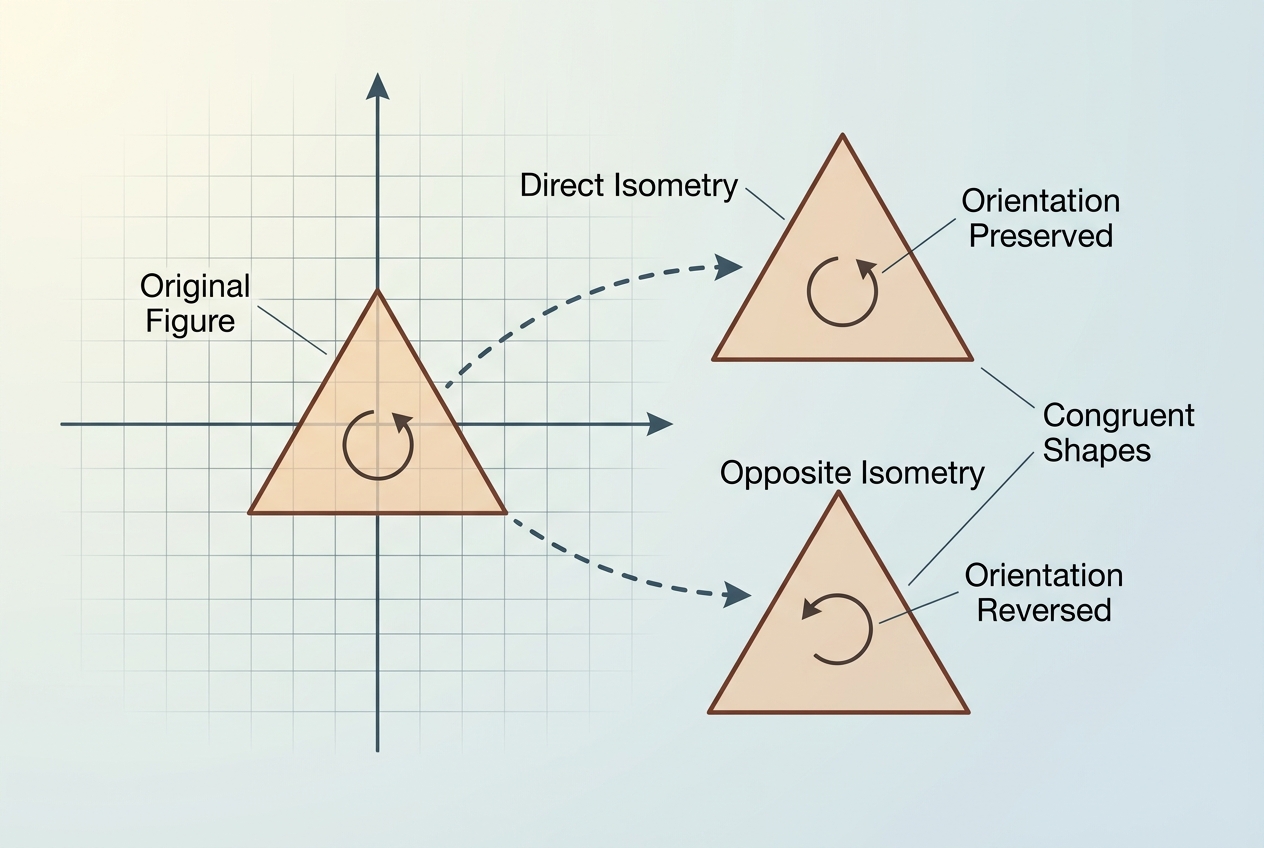
Combined transformations can feel like a puzzle where each move reshapes a figure, but the underlying rules stay consistent. In this case, the transformation T is defined by the mapping x' = y and y' = -x + 6, which swaps coordinates and shifts them. At first glance, this looks like a rotation or reflection, but the key twist is that the origin O(0,0) does not map to itself—it moves to (0,6). That single fact rules out any transformation centred at the origin, forcing you to look deeper. What makes this concept powerful is how it connects algebra to geometry. By applying T to each vertex of triangle PQR, you get new coordinates, but the real insight comes from checking what is preserved. The side lengths remain unchanged, so T is an isometry—a rigid motion that keeps distances intact. Since the origin isn’t fixed, the transformation must be a rotation about some other centre. To find that centre, you use perpendicular bisectors of the segments joining each original point to its image; their intersection reveals the pivot. This process shows how a simple rule can hide a more complex geometric action, and why verifying properties like orientation and fixed points is essential to fully describing a transformation.
Start practising IB questions today
150,000+ IB-styled questions, criteria-mapped and instantly accessible.