
Maths: Constants and Variables in Direct Proportionality
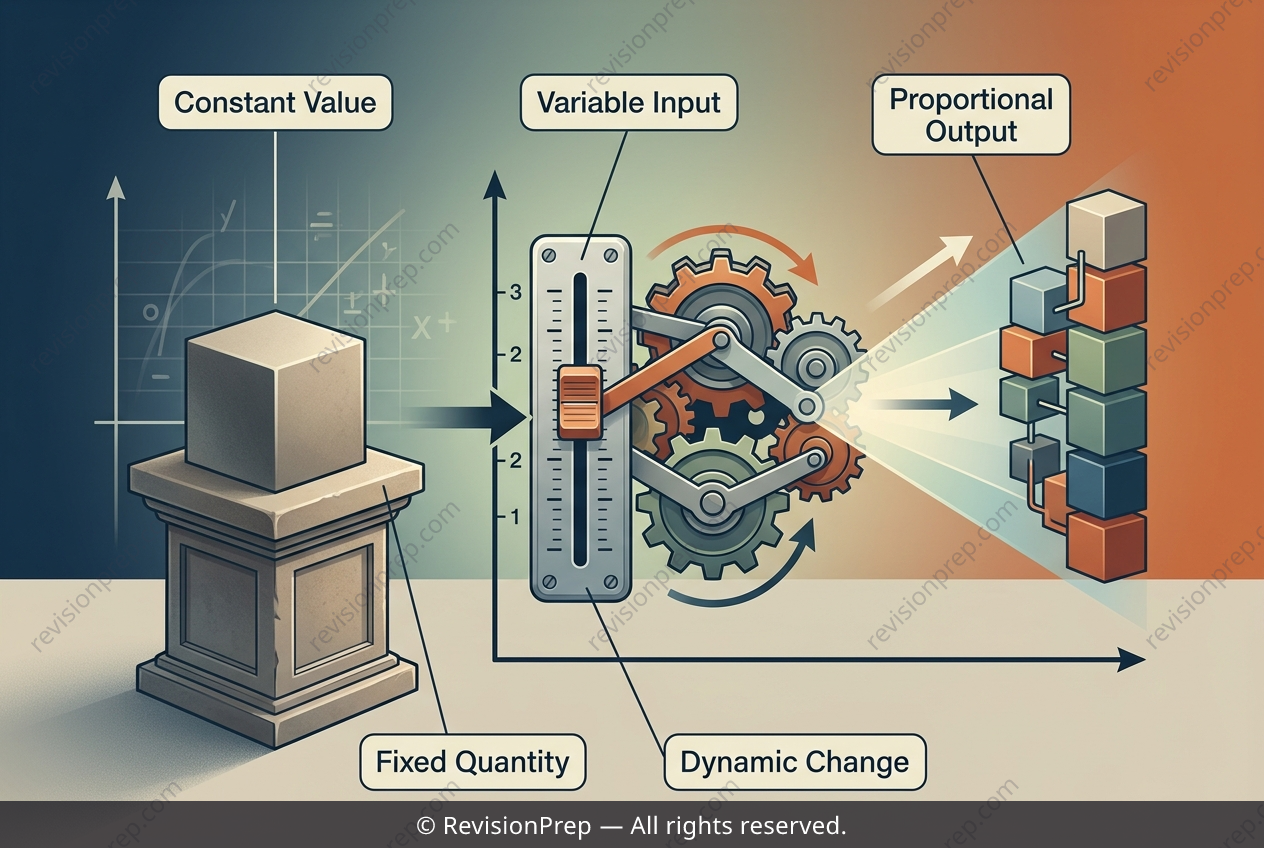
In mathematics, the ideas of constants and variables form the backbone of how we describe real-world patterns. A constant is a fixed value that never changes, while a variable represents a quantity that can shift depending on the situation. When these two work together, they create a direct proportionality—a simple but powerful relationship where one quantity changes at a steady, predictable rate relative to another. Consider a recipe that calls for a set amount of sugar per batch and a different set amount of flour per batch. Here, the sugar amount is the constant because it stays the same regardless of how many batches you decide to make. The flour, on the other hand, acts as a variable tied to the number of batches: for every single batch added, the total flour grows by a fixed multiple. This connection is written as total = rate × number of batches, where the rate (like 3 cups per batch) is the constant multiplier. Understanding this distinction helps you see how small, unchanging inputs can drive large, predictable outputs—a concept that appears everywhere from cooking to physics and economics.
Start practising IB questions today
150,000+ IB-styled questions, criteria-mapped and instantly accessible.