
Maths: Discrete vs Continuous Models: Substitution in Real-World Costs
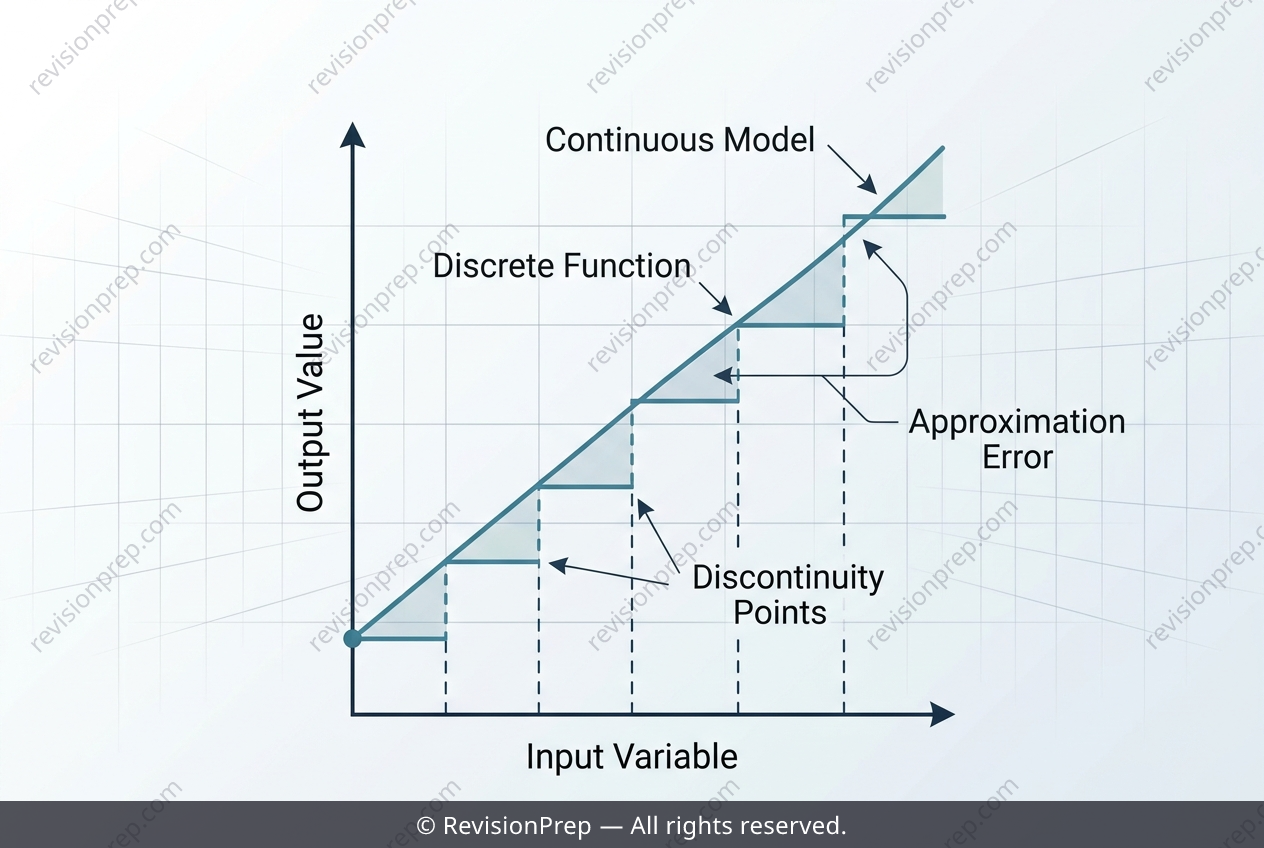
Substitution into expressions and formulae is one of the most direct ways mathematics models real-world situations—yet it often hides a subtle trap: the difference between a continuous model and a discrete one. When you plug a value into a formula, you assume the relationship behaves smoothly for every possible input. But many real-life pricing structures, like rental fees charged per half-hour block, are discrete: they only change at specific intervals, not continuously. In the kayak rental example, the student’s formula C = 25 + 10h treats h as a continuous variable, implying that every hour costs the same 10 dollars. However, the company’s actual pricing charges 10 dollars per 30-minute block, meaning the cost jumps at each half-hour boundary. This mismatch becomes visible when you substitute non-integer hours like 2.5 or 3.5: the formula smooths over the gaps, while the discrete structure forces you to round up to the next full block. Understanding this distinction—continuous versus discrete—is essential for interpreting models correctly, because a formula may be algebraically valid yet practically inaccurate for certain inputs.
Start practising IB questions today
150,000+ IB-styled questions, criteria-mapped and instantly accessible.