
Maths: Error Propagation in Word Problems: Area Calculations
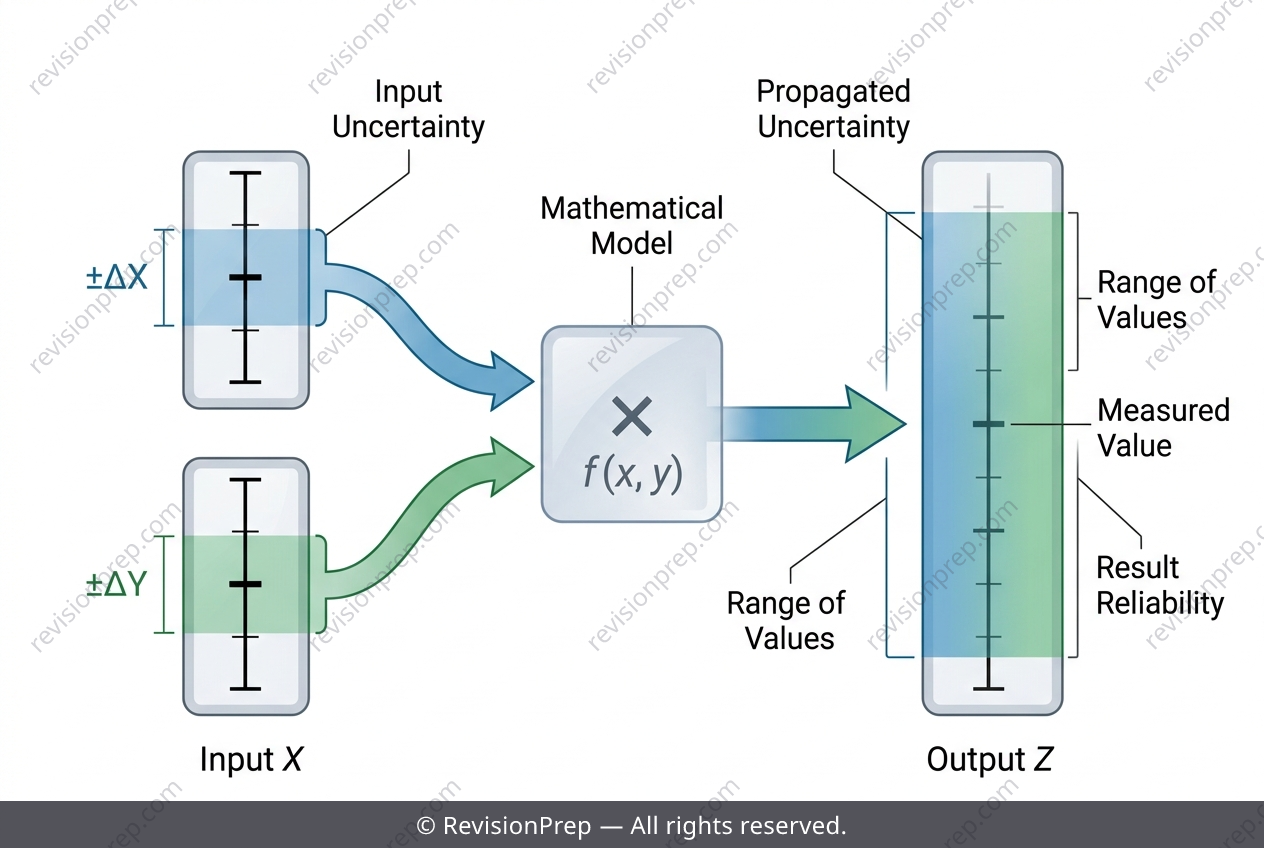
When you multiply two measured numbers, the uncertainty in each measurement doesn’t just disappear—it multiplies along with the values. In this problem, a tape measure accurate to ±0.1 m is used to find a rectangle’s length and width, and the area is calculated as A = l × w. At first glance, the product 8.2 × 5.1 seems to give a tidy, precise answer, but that precision is an illusion. The core idea here is error propagation: because the true length could be anywhere from 8.1 m to 8.3 m, and the width from 5.0 m to 5.2 m, the area is not a single number but a range. By plugging in the maximum possible dimensions, you get the upper bound, and with the minimum dimensions, the lower bound. The gap between these bounds reveals how much the original measurement uncertainty has been amplified through multiplication. This spread shows why reporting one value to four significant figures overstates reliability—the instrument simply cannot support that level of certainty, and the true area could lie anywhere within the wider interval.
Start practising IB questions today
150,000+ IB-styled questions, criteria-mapped and instantly accessible.