
Maths: Estimating Real-World Areas: Substitution in Formulae
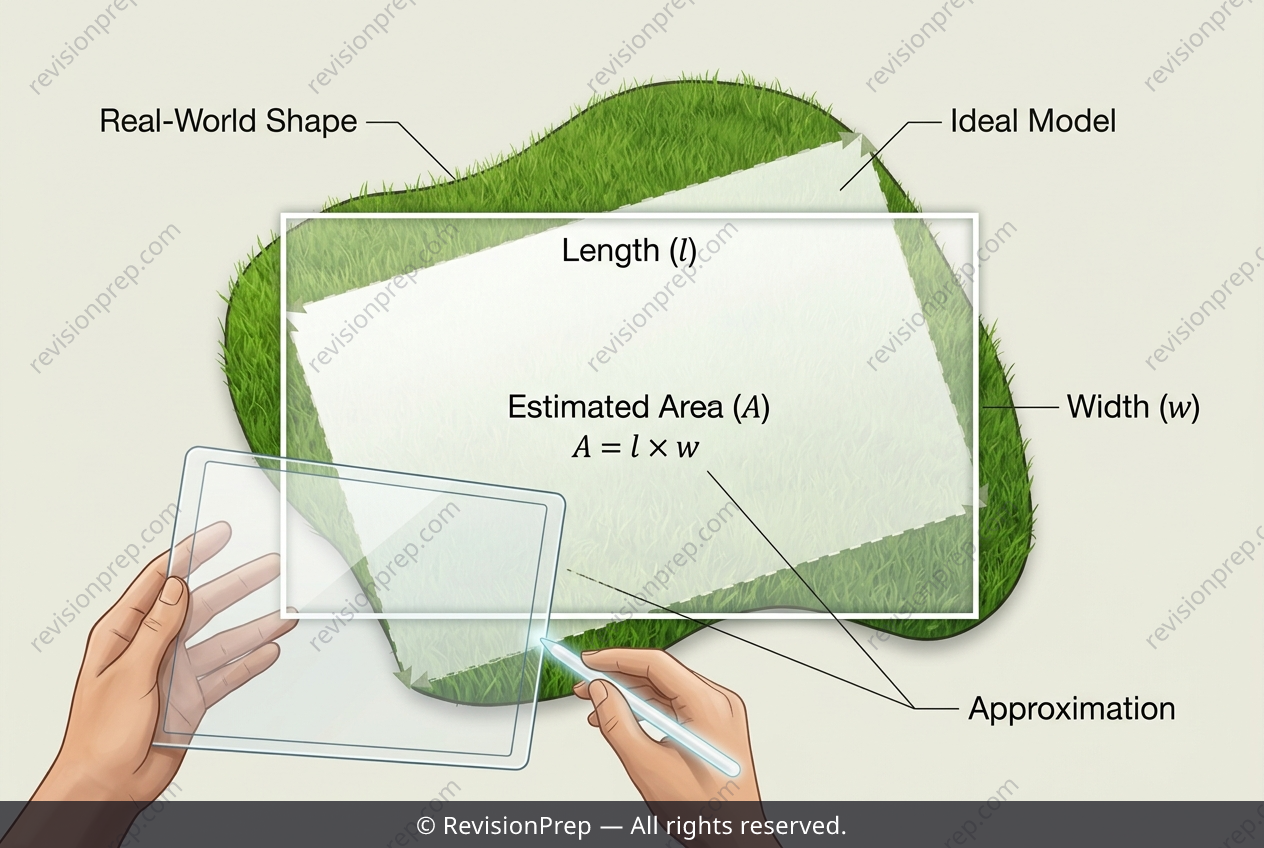
Substitution into expressions and formulae is the mathematical bridge between abstract algebra and the tangible world. At its heart, this topic asks you to take a general rule—like the formula for the area of a rectangle, A = l × w—and feed it real numbers to produce a useful result. But the true power of substitution lies not in the arithmetic, but in understanding what those numbers represent and how trustworthy the final output really is. In everyday life, this formula appears whenever someone needs to cover a two-dimensional space: buying carpet for a room, laying turf for a lawn, or painting a wall. Yet the calculated area is rarely an exact value. Why? Because real-world shapes are seldom perfect rectangles—walls curve, doorways create alcoves, and lawns have flowerbeds. Additionally, every measurement taken with a tape or laser carries a small degree of error. So while A = l × w gives a precise-looking number, that number is always an approximation, a practical estimate grounded in the assumptions we make about the shape and the accuracy of our tools. Recognising this gap between mathematical ideal and physical reality is what separates a mechanical calculation from genuine quantitative reasoning.
Start practising IB questions today
150,000+ IB-styled questions, criteria-mapped and instantly accessible.