
Maths: Expanding Brackets with Real-World Modeling and Reliability
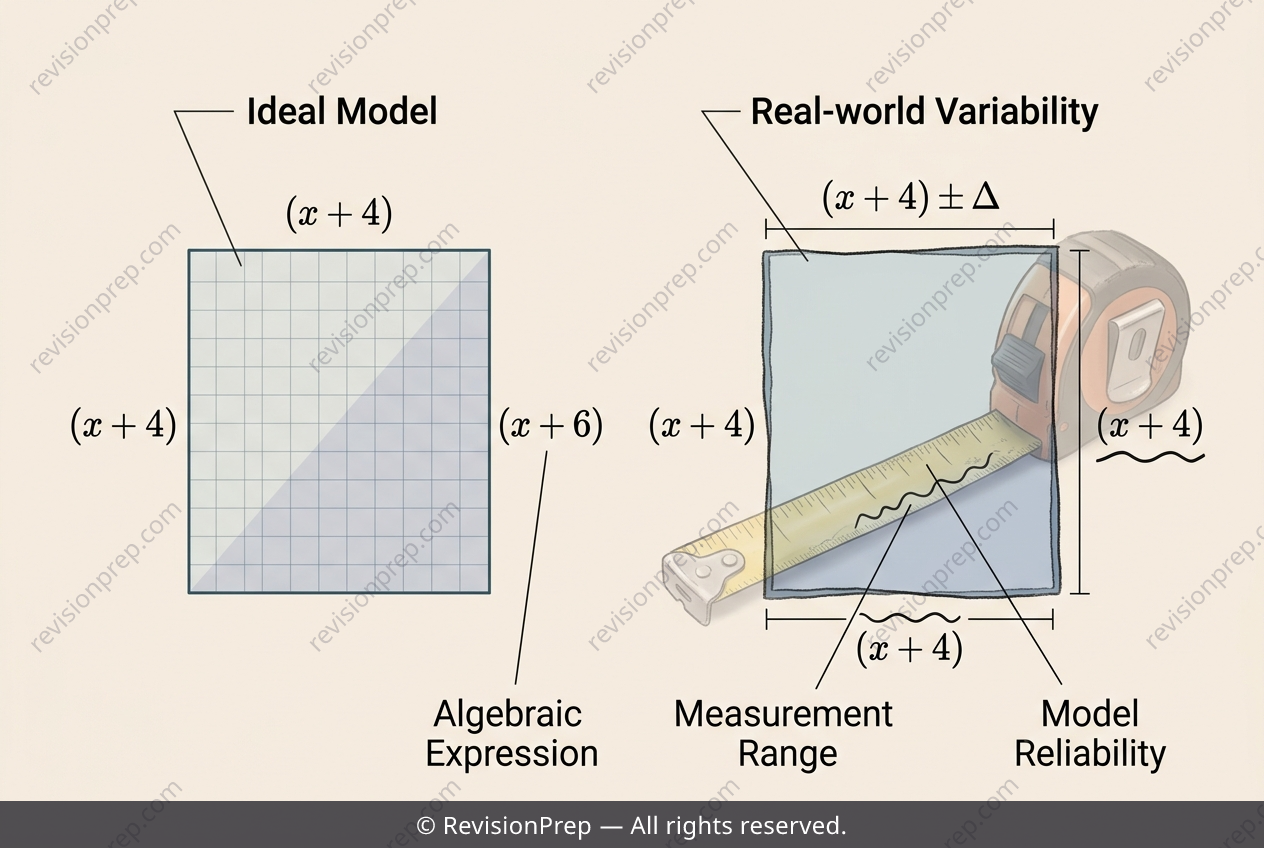
Expanding and factorising single brackets is where algebra starts to feel like a tool rather than a puzzle. At its heart, this topic asks you to rewrite expressions in equivalent forms—turning a product like (x + 4)(x + 6) into a sum of terms, or reversing that process to spot common factors. The real power, though, lies in how these manipulations let you model real-world situations: here, a rectangular garden with a surrounding path becomes a neat algebraic expression for total area. What makes this concept matter is the bridge between structure and meaning. The expansion (x + 4)(x + 6) = x² + 10x + 24 isn’t just a rule to memorise—it encodes how the garden’s length and width combine with the path’s fixed width. When you substitute a value for x, the expression gives a concrete number, but the model’s reliability depends on that fixed width being accurate. If the path varies, as the marking scheme notes, the expression over- or under-estimates the true area. Recognising this limitation—and improving the model by using an average measured width—turns a simple algebraic exercise into a lesson in mathematical modelling and the assumptions behind every formula.
Start practising IB questions today
150,000+ IB-styled questions, criteria-mapped and instantly accessible.