
Maths Extended: Domain and Range: Real-World Parabola Problems
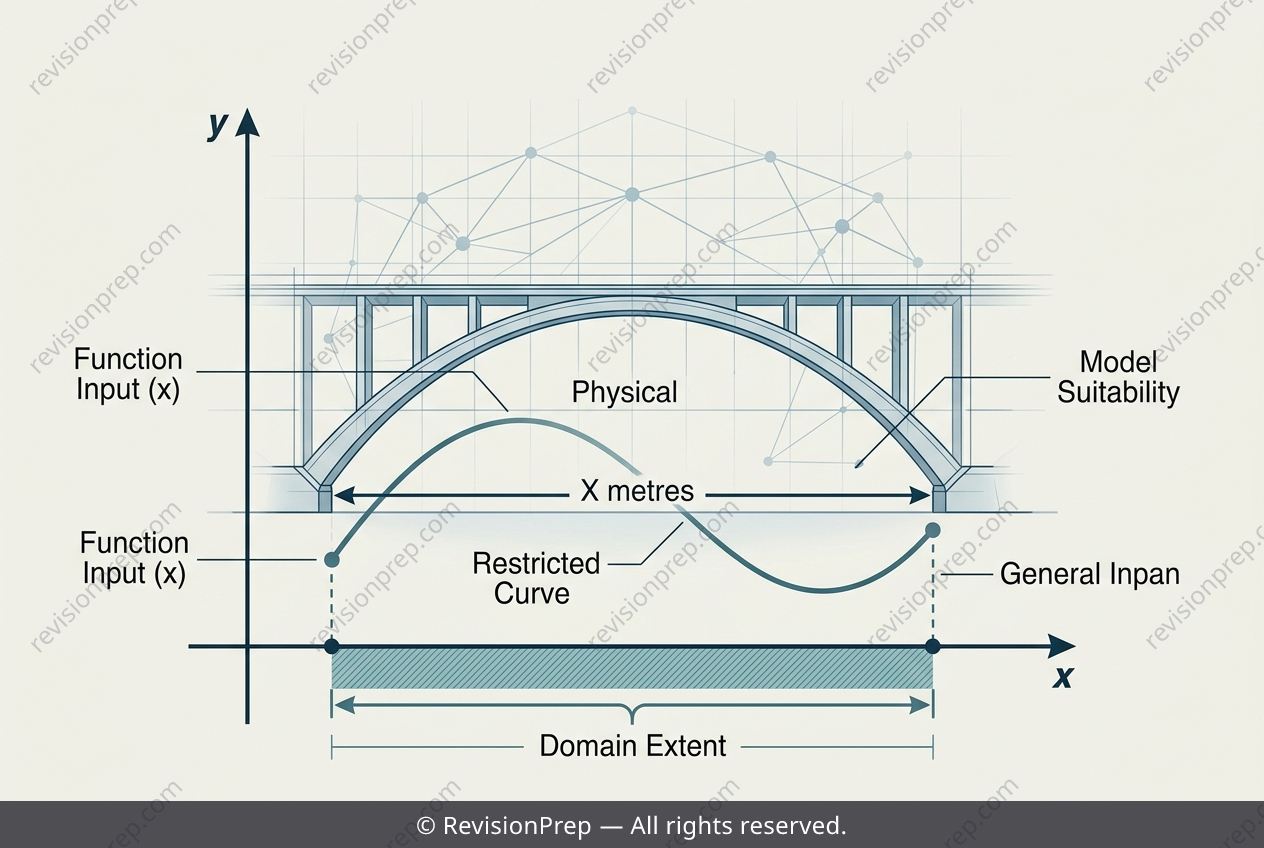
When a function is drawn as a curve, its domain is the complete set of input values for which that curve actually exists. For a parabola that opens upward with its vertex at (0, -3) and x-intercepts at (-2, 0) and (2, 0), the solid arc is drawn only between those intercepts. This means the function is defined exclusively for x-values from -2 to 2, inclusive. In set-builder notation, that is { x ∈ ℝ | -2 ≤ x ≤ 2 }, and in interval notation, it is [-2, 2]. The endpoints are included because the curve is solid at those points, not open circles. Understanding domain is not just a notation exercise—it directly links to real-world constraints. Here, the domain tells us the horizontal width the arch covers: the distance from the left intercept to the right intercept is 2 - (-2) = 4 units. If a designer needs the arch to span at least 5 metres, this model fails because its usable width, dictated entirely by the domain, is shorter than the requirement. The domain isn’t just a set of numbers; it defines the physical limits of the model, and any application must respect those boundaries.
Start practising IB questions today
150,000+ IB-styled questions, criteria-mapped and instantly accessible.