
Maths Extended: Domain and Range Through Error Analysis in Motion Models
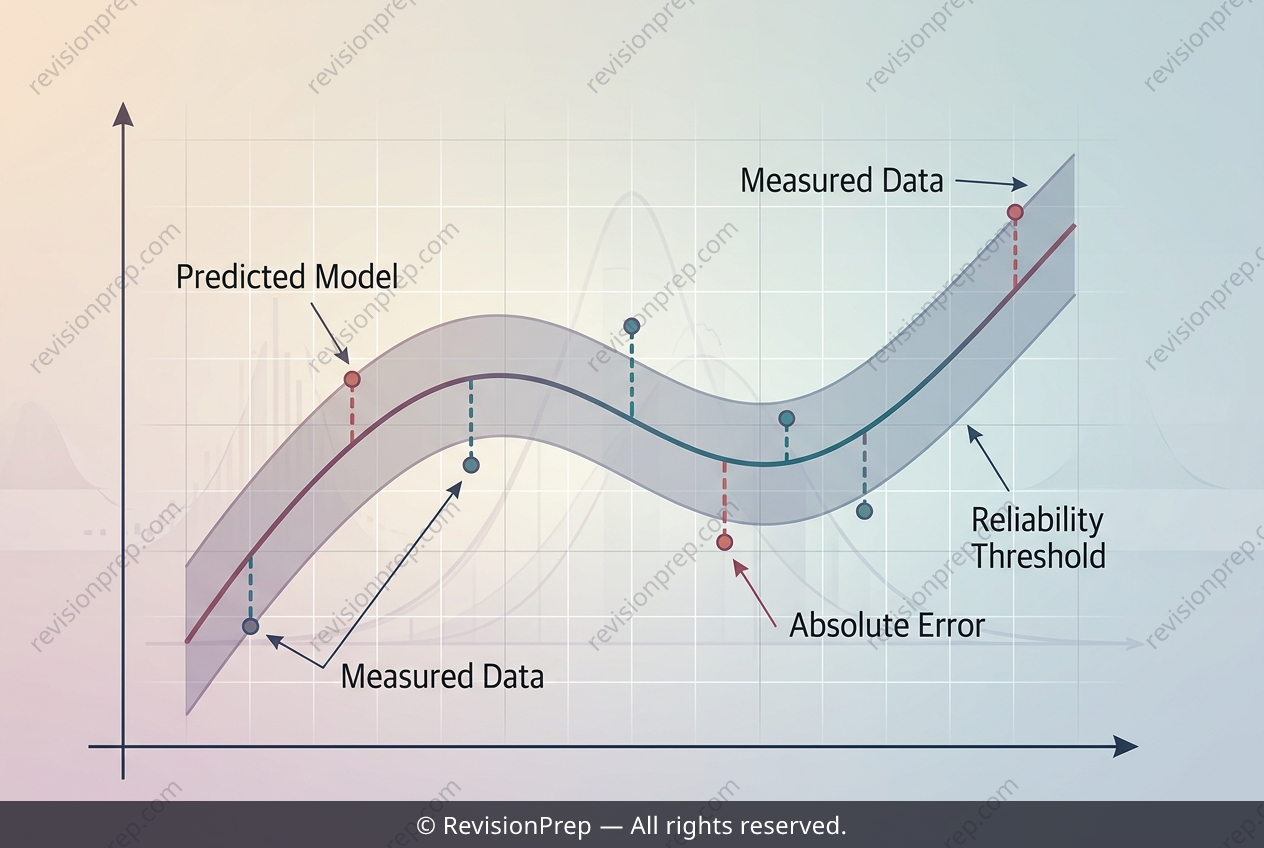
When a ball is thrown upward, its motion can be described by a quadratic model like h(t) = -4.9t² + 14.7t + 1.5. This equation predicts the height at any time t, but a model is only useful if it faithfully mirrors reality. The core idea here is model validation: comparing predicted values against measured data to quantify how much trust we can place in the equation. The process hinges on absolute error, calculated as |predicted – measured|. By evaluating the model at each recorded time, you generate a set of predicted heights, then subtract the observed values to see where the model diverges. This reveals not just whether errors exist, but their size and location—crucial for safety-critical decisions. A single large error, even if others are tiny, can invalidate the entire model. Here, the tolerance is ±0.5 m; if any error exceeds that, the model fails the reliability test. Understanding this connection—between formula output, error magnitude, and real-world consequence—turns a simple quadratic into a tool for judgment, not just calculation.
Start practising IB questions today
150,000+ IB-styled questions, criteria-mapped and instantly accessible.